
ブログ
Effectiveness of Design Rights in Japanese Customs Enforcement
2026.05.07
SHARE


In recent years, Japan’s border enforcement system has evolved into an increasingly powerful tool for combating counterfeit products through the strategic use of design rights. This article outlines the key features and practical advantages of this system.
Strong Authority of Customs to Determine Infringement
One of the most distinctive features of the Japanese system is that customs authorities have the authority to determine whether a design right has been infringed.
Under the Customs Act of Japan, customs may initiate a determination procedure and, upon finding infringement, seize or destroy the goods. This integrated system—under which customs authorities handle both the suspension of goods and the infringement determination—is relatively unique by international standards.
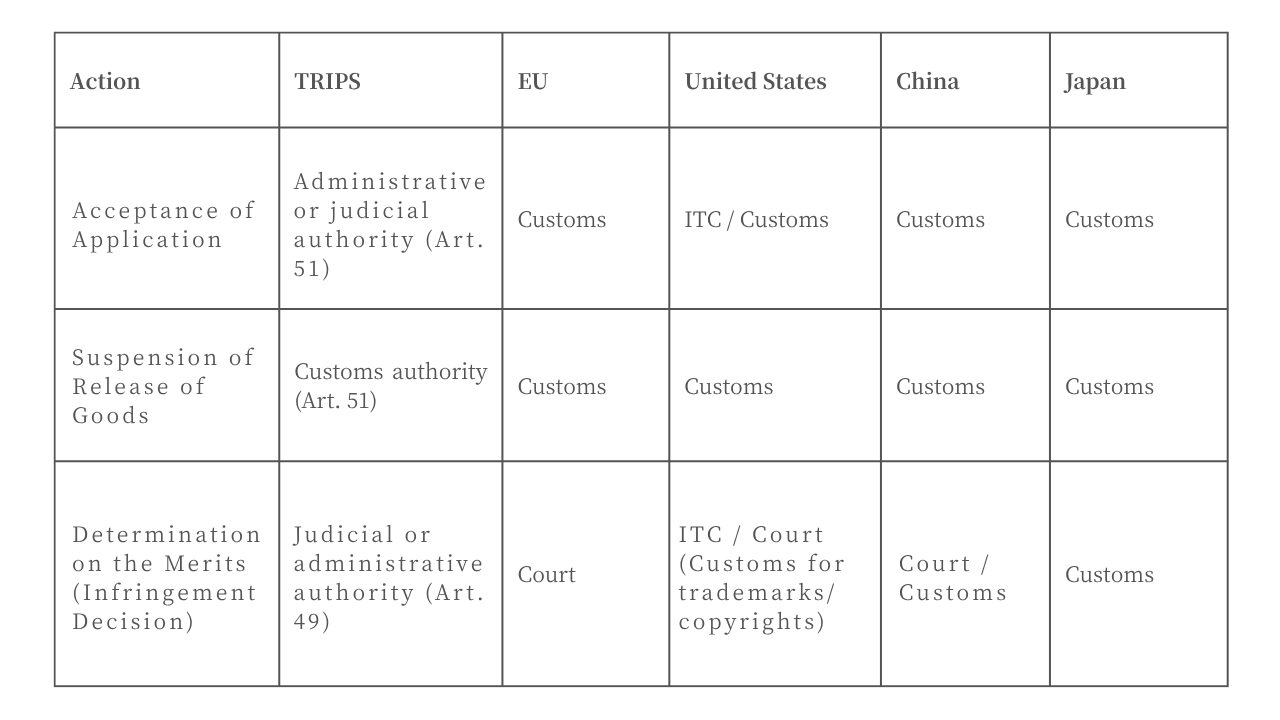
In contrast, jurisdictions such as the United States, the EU, and China often require judicial involvement or decisions by specialized tribunals to determine infringement.
Namely, in the United States and China, customs authorities primarily determine infringement for trademarks and copyrights, while patents and designs generally require decisions by courts or specialized bodies (e.g., the ITC). Japan is distinctive in that customs authorities handle the entire process, from application to final determination. (See the table below for an international comparison.)
Consequently, the Japanese system enables faster and more effective enforcement.
Comparison of Border Enforcement Systems (International Overview)
Increasing Practical Use of Design Rights
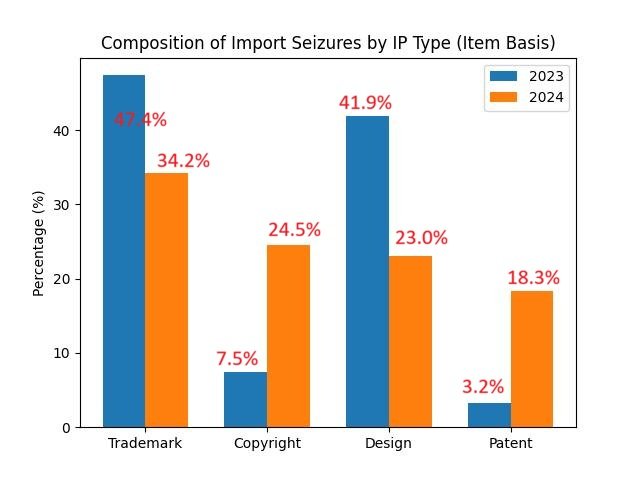
Statistical trends indicate that design rights are becoming a key tool in customs enforcement. Recent data shows that design right-based seizures account for approximately 23% to over 40% of all seized items, depending on the year (e.g., about 41.9% in 2023 and 23.0% in 2024).
This significant share of design right-based seizures indicates that design rights have become an increasingly important enforcement pillar alongside trademarks.
Broad Enforcement via Partial Designs
Another important feature of the Japanese system is that customs authorities recognize and enforce design rights covering only a part of a product (“partial designs”).
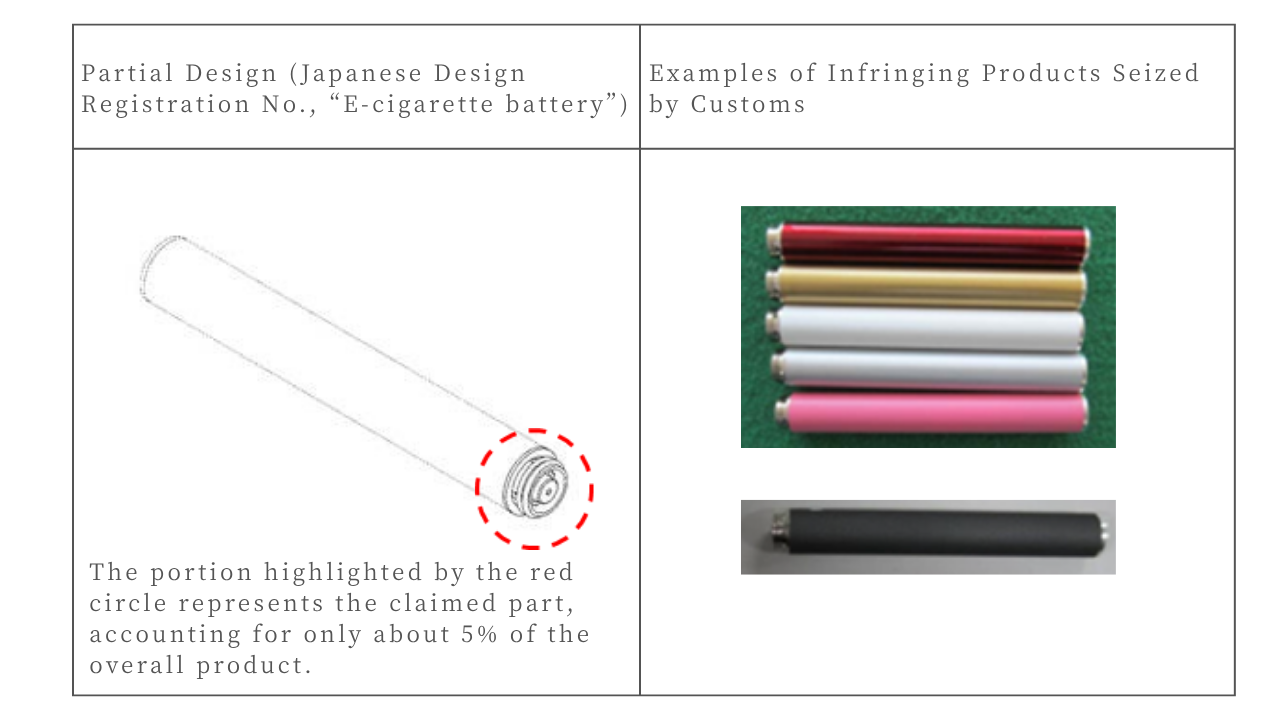
In practice, Japanese customs may suspend the importation of an entire product even where the asserted design right protects only a specific portion of that product, provided that the protected portion is found to be infringed. This reflects a practical and enforcement-oriented approach at the border, allowing right holders to take effective action not only based on the overall product configuration, but also on key design elements.
As a result, partial designs can serve as a powerful tool in customs enforcement, particularly for protecting functionally important or interchangeable components, even when the overall appearance of the product differs.
To illustrate this point, the figure below shows an actual enforcement case in which a design right covering only a very small portion of a product (approximately 5% of the overall configuration) was successfully used to block the importation of the entire product.
Conversion from Patent to Design Applications
Japan allows conversion from a patent application to a design application.
Although not widely known among foreign practitioners, Japan provides a system that permits applicants to convert a pending patent application into a design application.
One of the key advantages of this system is that it can be used to “rescue” subject matter that does not meet the requirements for patentability, such as inventive step, but still has commercially valuable design features.
In addition, an important strategic aspect arises from differences in prosecution timelines. Design applications in Japan are typically registered relatively quickly (often within about six to eight months), meaning that competitors may review the published design and attempt to develop products that avoid infringement.
In contrast, patent applications can remain pending before the Japan Patent Office (JPO) for several years. By leveraging this feature, applicants can maintain a patent application on file and, if imitation products emerge at a later stage, convert the patent application into a new design application. This enables the applicant to obtain a design registration tailored to cover imitation products that were deliberately designed to avoid earlier registered designs.
In this sense, the conversion system is a highly effective tool for addressing sophisticated design-arounds.
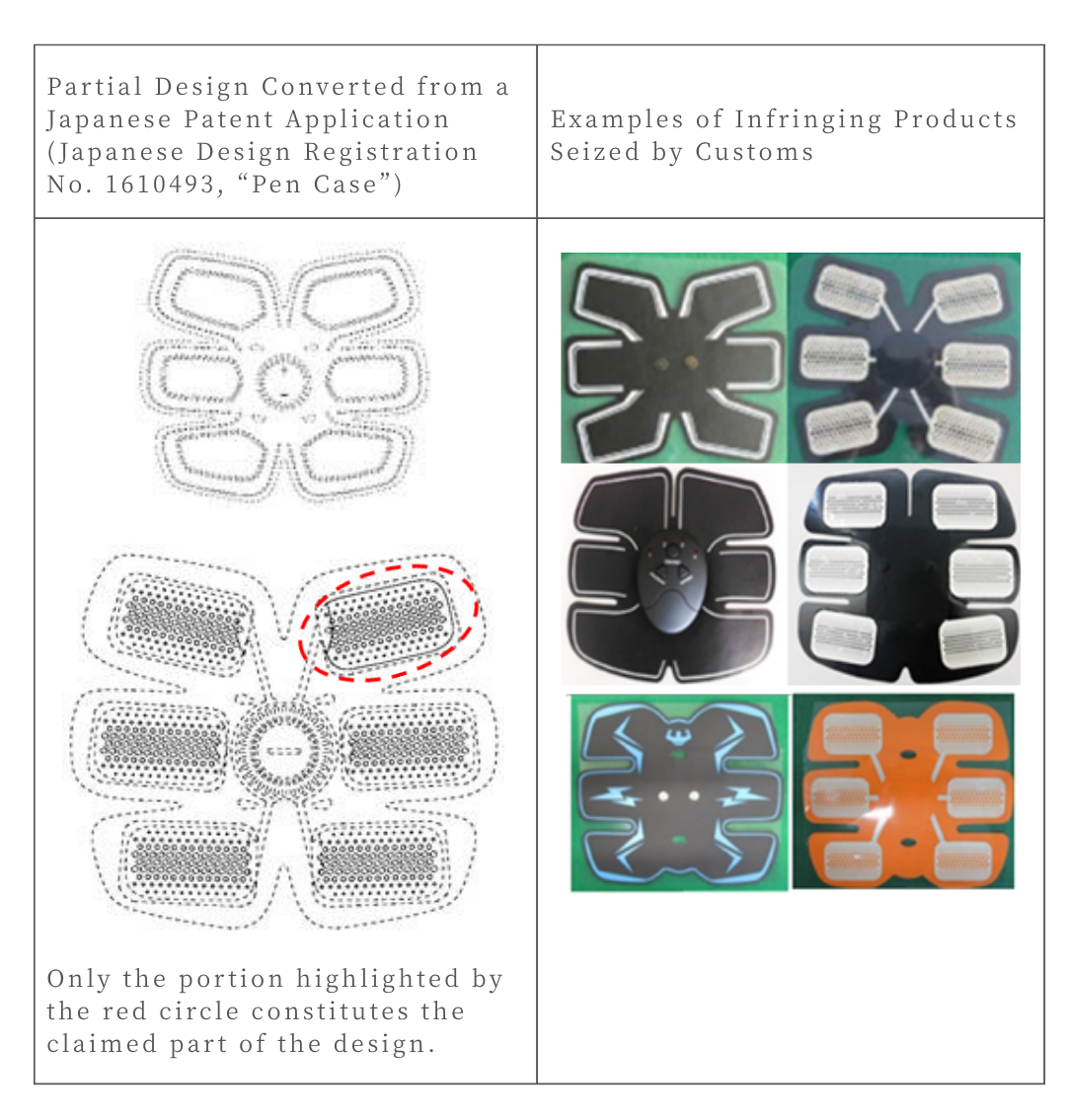
There are actual cases where design rights obtained through such conversion from patent applications were successfully used to eliminate imitation products. Two examples are shown below.
(Case 1)
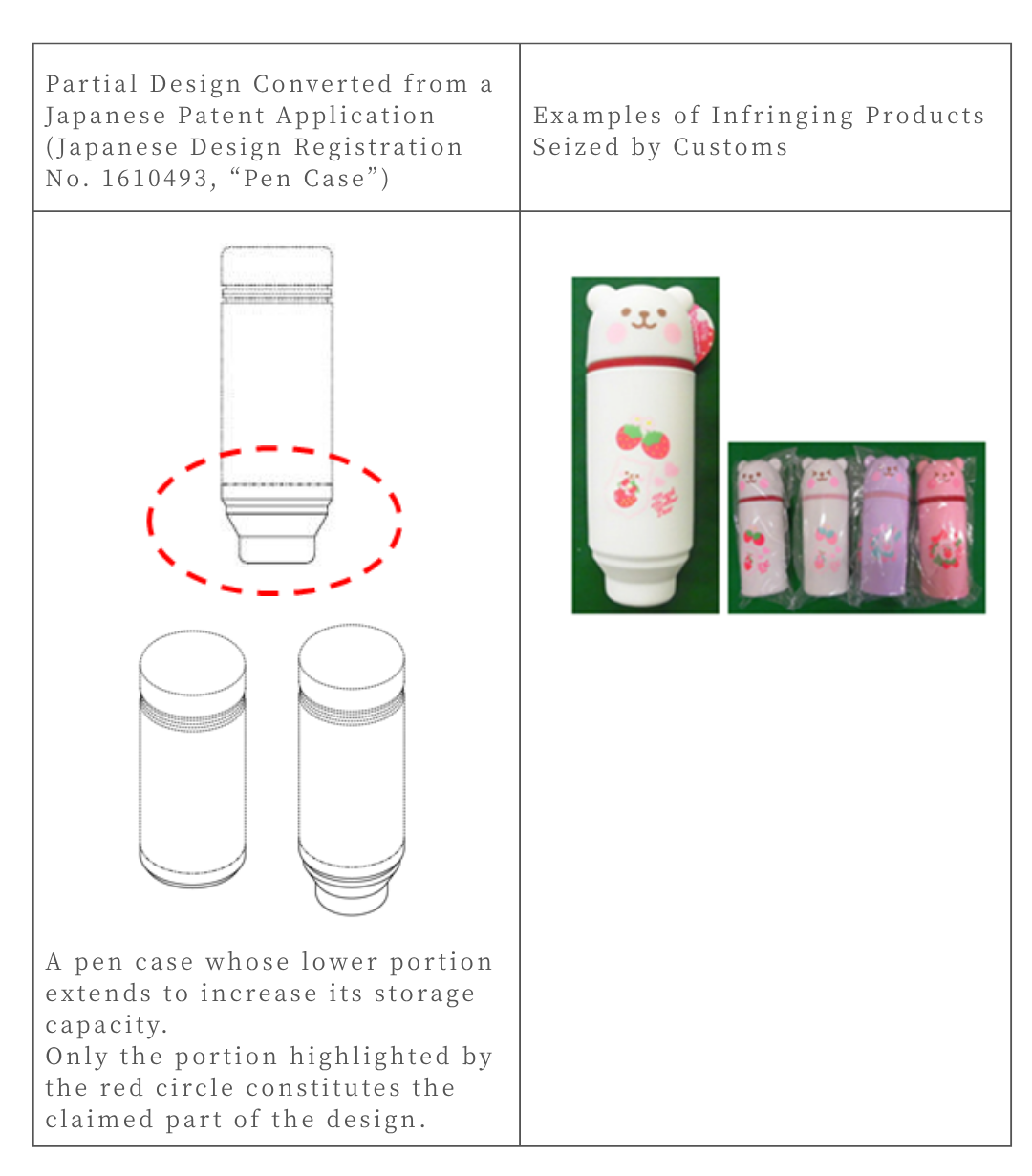
(Case 2)
Conclusion
Japan’s customs enforcement system offers:
- Strong authority of customs to determine infringement
- Increasing practical use of design rights
- Broad protection through partial designs
- Flexible strategies via application conversion
These features make design rights a highly effective tool for border enforcement in Japan.
For companies entering the Japanese market, leveraging design rights for customs enforcement should be considered an important part of their anti-counterfeiting strategy.
Member
PROFILE

SHARE