
ブログ
The Japanese Supreme Court’s Judgment in the TRIPP TRAPP Case
2026.05.01
SHARE


The Supreme Court of Japan issued the long-awaited judgment on the copyrightability of applied art in the Stokke v Noz case on April 24, 2026. Although the Court denied copyrightability for the product at issue, the decision sets out, for the first time, a general requirement for the copyrightability of applied art. (Note 1)
Overview of the Case
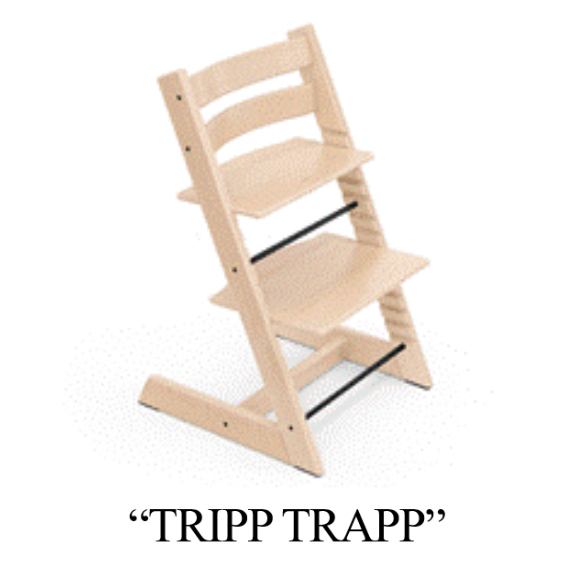
Stokke AS (“Stokke”), a Norwegian company that manufactures and distributes the well-known chair “TRIPP TRAPP”, designed by Mr. Peter Opsvik, was the plaintiff and the defendant was Noz Co., Ltd., a Japanese furniture manufacturer. Stokke brought claims for copyright infringement and unfair competition in relation to the defendant’s products, but both the Tokyo District Court, as the court of first instance, and the Intellectual Property High Court, as the appellate court, dismissed Stokke’s claims. Accordingly, Stokke filed a petition for acceptance of final appeal with the Supreme Court.
The legal issue before the Supreme Court focused on the copyrightability of the TRIPP TRAPP (Note 2). In practice, it is extremely rare for the Supreme Court to accept cases for review in Japan, with the acceptance rate being less than 1%. Nevertheless, the Supreme Court decided to accept the appeal. Given that the lower-court precedents regarding the requirement for the copyrightability of applied art had been unclear and inconsistent, it was expected that the Supreme Court would clarify the requirement (Note 3). The decision has now been finally rendered.
Summary of the Judgment
In conclusion, the Supreme Court denied copyrightability for the TRIPP TRAPP and dismissed the appeal. In its reasoning for the dismissal, the Supreme Court set out and clarified a general requirement for the copyrightability of applied art. It should first be noted that the Supreme Court did not use the term “applied art”, but instead defined mass-produced products to be used for daily life as
“Mass-produced Utilitarian Products”.
The Supreme Court first clarified that, even where Mass-produced Utilitarian Products constitute “creatively produced expressions of thoughts or sentiments”, which is the definition of copyrighted work under the Copyright Act, Mass-produced Utilitarian Products should not always be considered copyrighted works. The Supreme Court reasoned that the designs of such products may be protected as registered designs under the Design Act, and that granting additional protection under the Copyright Act would undermine the purpose of the Design Act.
On the other hand, the decision did not entirely exclude the possibility of copyright protection for such Mass-produced Utilitarian Products. The Court held that Mass-produced Utilitarian Products may be protected as copyrighted works where “the configuration of the whole or a part of the Mass-produced Utilitarian Products can be conceptually perceived, independently from the elements derived from function, as a creatively produced expression of thoughts or sentiments”. Applying this requirement, the Court held that the TRIPP TRAPP was not copyrightable on the basis that its configuration could not be perceived as a creatively produced expression independently from its function as a children’s chair.
One of the Supreme Court Justices added a supplementary opinion to the judgment, clarifying the background to, and scope of, the decision (the “Supplementary Opinion”). In the Supplementary Opinion, the Justice clarified that Mass-produced Utilitarian Products may be protected under the Copyright Act, but that the scope of such protection should be considered by taking into account the subject matter, purpose, requirements and procedures, as well as the scope and duration of the rights under the Copyright Act and the Design Act. Furthermore, the Justice stated, although international harmonization may be taken into account in the field of intellectual property law, there are significant differences between Japanese law, on the one hand, and US and EU laws, on the other. Accordingly, the scope of protection for applied art in Japan need not be aligned with the protection available under US or EU laws.
More importantly, the Supplementary Opinion makes clear that the decision deliberately did not use the term “aesthetic appreciation”, which had been used in the judgment of the Intellectual Property High Court in this case, because that term may give rise to a misunderstanding that a high degree of creativity or artistic quality is required. It further clarifies that the Supreme Court also considered it inappropriate for a court to determine whether a work is an object of aesthetic appreciation. The Supplementary Opinion concludes by expressing the expectation that, although the requirement provided by the Supreme Court in this case may not yet be sufficiently clear, the scope of copyrightability of the Mass-produced Utilitarian Products under the requirement will be clarified through the accumulation of future cases.
Comments
Although the decision did not use the term “applied art”, but instead used the term “Mass-produced Utilitarian Products”, the decision substantially sets out the requirement for the copyrightability of applied art. This decision is highly significant, given that the requirement for the copyrightability of applied art had been unclear and inconsistent in lower-court precedents, and that this is, in substance, the first Supreme Court decision in Japan to address that requirement.
The Supreme Court recognized the possibility of copyright protection for applied art where “the configuration of the whole or a part of the Mass-produced Utilitarian Products can be conceptually perceived, independently from the elements derived from function, as a creatively produced expression of thoughts or sentiments”. It should be noted that this requirement indicates that (i) even the configuration of a part of a product could be protected by copyright; (ii) configuration derived from function is not protected; and (iii) copyright protection will be granted only to design elements that are conceptually independent from design derived from function. Furthermore, it is quite significant that the Supplementary Opinion clarifies that a high degree of creativity or artistic quality is not required for the copyrightability of applied art.
In light of the requirement and given that the decision denied copyrightability for the TRIPP TRAPP, minimalist designs that are closely associated with the function of the relevant products may be difficult to protect by copyright. On the other hand, where a product incorporates decorative elements whose designs do not serve any functional purpose, or where the configuration of the product is wholly unrelated to its function, those designs may be protected as copyrighted works even without a high degree of creativity or artistic quality.
The scope of copyright protection for applied art has long been unclear and inconsistent in Japan, and this decision finally provides a definitive requirement for the copyrightability of applied art, although the scope of protection remains to be fully clarified. In particular, the meaning of “can be conceptually perceived as a creatively produced expression of thoughts or sentiments” and “independently from the elements derived from function” is not entirely clear, and the scope of the protection under the requirement is expected to be clarified in future cases.
Finally, it should be borne in mind that even where copyright protection is not available, this does not mean that product designs are unprotected. They may be protected under the Design Act once registered. In addition, if the configuration of a product becomes famous and thereby acquires distinctiveness, it may be registered as a three-dimensional trademark under the Trademark Act (Note 4), and may also be protected under the Unfair Competition Prevention Act.
(Note 1) https://www.courts.go.jp/assets/hanrei/hanrei-pdf-95904.pdf
(Note 2) As background, in 2010, the Tokyo District Court denied copyright protection for the TRIPP TRAPP. However, in 2015, in a different case, the Intellectual Property High Court held that the TRIPP TRAPP is copyrightable. Then, in September 2024, in the present case, the Intellectual Property High Court reached the opposite conclusion and held that the TRIPP TRAPP is not copyrightable.
(Note 3) See our previous article “Copyright Protection for Applied Arts in Japan”:
(Note 4) For example, the configuration of the TRIPP TRAPP has already been registered as a three-dimensional trademark.
Member




SHARE