
ブログ
Copyright Protection for Applied Arts in Japan
2026.04.10
SHARE


Introduction
In Japan, there are no unified standards for determining the copyrightability of aesthetic creations that are used in practice or industrially – the so-called “applied arts.” There are no standards provided under copyright law, and there have been no Supreme Court decisions directly addressing this issue. As a result, Japanese case law has developed in a highly fragmented manner, with courts adopting different standards in different cases, reaching inconsistent conclusions.
This article provides an overview of the current legal framework governing the protection of applied arts in Japan. In a subsequent article, we plan to analyze the forthcoming Supreme Court decision in the TRIPP TRAPP case, expected on April 24, 2026.
TRIPP TRAPP Cases
A prominent example of how courts adopt different standards in different cases is the series of decisions regarding the copyrightability of the globally well-known children’s chair, the “TRIPP TRAPP”.
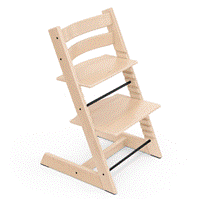
In 2010, the Tokyo District Court denied copyright protection for the TRIPP TRAPP. However, in 2015, in a different case, the Intellectual Property High Court (IP High Court), which hears appeals from district courts in intellectual property cases, held that the TRIPP TRAPP was copyrightable. Then, in September 2024, in another case, the IP High Court reached the opposite conclusion and held that the TRIPP TRAPP was not copyrightable.
The decision in 2024 is particularly noteworthy because the IP High Court provided a different conclusion from its own earlier conclusion on the same product, in spite of the same factual circumstances. Those inconsistent cases clearly show the confusion and lack of consistency in Japanese case law regarding the copyrightability of applied arts.
The 2024 decision has been appealed to the Supreme Court. Although the Supreme Court has rarely accepted cases for review in Japan (the acceptance rate is less than 1%), it decided to hear this case. An oral hearing was held on March 16, 2026, and the judgment will be rendered on April 24, 2026. It is expected that the Supreme Court will provide a unified standard for assessing the copyrightability of applied arts in Japan.
Protection of Applied Arts in Japan: Design Act and Copyright Act
In Japan, applied arts lie at the intersection of the Design Act and the Copyright Act. Accordingly, discussions on whether applied arts should be protected as copyrightable work have often focused on how to delineate the respective scopes of these two regimes.
There have been various discussions among academics with respect to the relationship between design rights protection and copyright protection. It is generally accepted that applied arts should be protected under copyright law to some extent, but the scope of such protection remains unclear, and the Supreme Court has not addressed this issue.
Looking back at the legislative history, it was initially intended that the scope of protection under the Design Act be kept separate from that under the Copyright Act. Following the revision of the Berne Convention in 1948, when major countries in the world adopted legal systems that protect applied arts under copyright law, it was examined in Japan whether applied arts should receive broader protection under the Copyright Act. However, as a result, partially due to strong opposition from the design industry, it was only clarified by the 1970 amendment to the Copyright Act that artistic craftsmanship (i.e., artistic craftwork produced as single items) is protected under copyright law, while the treatment of other forms of applied arts was left for future consideration. Therefore, even after the 1970 amendment to the Copyright Act, the scope of protection for applied arts remained unclear, which led to subsequent decisions applying different standards.
Supreme Court Decisions
Up to 2025, there has been no Supreme Court decision in Japan that clearly establishes a general standard for determining the copyrightability of applied arts. However, the following two Supreme Court decisions are often referred to as relevant cases in this context.
(i) Nychair Case (Supreme Court, March 28, 1991)
This case concerned the copyrightability of a chair known as the “Nychair.” In the lower court judgment of February 14, 1990, regarding the criteria for determining the copyrightability of applied arts, the court held that applied arts protected under the Copyright Act are limited to “Artistic Craftsmanship” as defined in the Copyright Act, and further ruled that “‘Artistic Craftsmanship’ refers to items that, while possessing practical utility, are regarded solely as objects of aesthetic appreciation in their own right, as complete works of art, apart from their practical and functional aspects”; and the Supreme Court upheld this ruling. It should be noted that this decision merely upheld the decision in the lower court and did not provide any substantive reasoning by the Supreme Court itself.
(ii) Gona U Case (Supreme Court, September 7, 2000)
This case addressed the copyrightability of typefaces. The Supreme Court established the following criteria for determining whether a typeface qualifies as a copyrighted work: “It must possess originality, such as having distinctive features compared to conventional typefaces, and it must also possess aesthetic qualities that make it capable of being appreciated as a work of art in its own right”. Although this decision specifically concerns the copyrightability of typefaces, typefaces share with applied arts the characteristic of being used for practical purposes. Therefore, the case is often considered a relevant precedent for assessing the copyrightability of applied arts.
Lower Court Decisions and Three Theories
While there are numerous court precedents from high courts and district courts regarding the copyrightability of applied arts, those decisions are generally understood to be based on the following three theories: (i) Fine Art Equivalence theory, (ii) Separability theory, and (iii) Non-Distinction theory:
(i) Fine Art Equivalence theory
Fine Art Equivalence theory holds that, with regard to applied arts, only works that can be regarded as equivalent to fine art or that possess a high degree of creativity are protected as copyrighted works.
(ii) Separability theory
Separability theory holds that if the aesthetically appreciable elements of a useful article can be identified as separate from the practical function (or the structure necessary for the practical purpose), it may be protected as a copyrighted work.
(iii) Non-Distinction theory
Non-Distinction theory holds that the copyrightability of applied arts should be determined according to the same criteria as those applied to other copyrightable works.
Fine Art Equivalence theory was adopted in earlier cases, while many of the recent decisions on applied arts are considered to have adopted Separability theory, and only a few are considered to have adopted Non-Distinction theory. Furthermore, even among decisions adopting the Separability theory, there is no consistency in how practical or functional elements are to be separated. In any event, courts have recognized copyrightability in only a small number of cases.
Long-Awaited Supreme Court Decision
There are currently no established standards in Japan for determining the copyrightability of applied arts. Courts have adopted different criteria in different cases, and even among decisions that are considered to have adopted the same theory, there are notable differences in how those criteria are applied to determine the copyrightability of applied arts.
The Supreme Court’s decision for the TRIPP TRAPP case, scheduled to be rendered on April 24, 2026, is expected to provide a unified framework for assessing the copyrightability of applied arts in Japan. Many legal practitioners and others are now awaiting the forthcoming decision with great interest to see how the court will address this long-standing issue.
Member




SHARE