
ブログ
[Crisis Management & Compliance] "Overview of the 2025 Amendment to the Act on Control and Improvement of Amusement Business: Stricter Penalties and Expansion of Disqualification Criteria for Business Licenses(All Amusement Businesses)"
2026.03.11
SHARE


Introduction
Regarding the 2025 Amendment to the Amusement Act on Control and Improvement of Amusement Business, the first blog post provided an overview of the entire structure (Link: https://www.tmi.gr.jp/eyes/blog/2025/17382.html), the second post detailed compliance matters and prohibited acts for the "entertaining and food and drink-serving business amusement" (Link: https://www.tmi.gr.jp/eyes/blog/2025/17558.html), and the third post explained the prohibition of “kickbacks paid to procurers for the referral of female employees to sex industry establishment as sex workers’’ and the Employment Security Act (Link: https://www.tmi.gr.jp/eyes/blog/2025/17746.html). In this post, we will explain the stricter penalties for unlicensed operation and the expansion of disqualification criteria for business licenses. This article is based on discussions within TMI Associates’ Amusement Business Law Firm Research Group.
Scope of Businesses
The strengthening of penalties for unlicensed operation and the expansion of disqualification criteria for business licenses under this amendment affect all "Amusement Businesses" (Categories 1–5) and "Special Nighttime Food and Beverage Businesses". This includes not only businesses providing service with amusement but also business which allow the customers to play games that are likely to stimulate customers' desire for gains by chance (Categories 4 and 5).
"Specified Amusement-Providing and Food and Drink-Serving Businesses" are not legally classified as "Amusement Businesses" but are subject to a licensing system and thus affected (specifically regarding the expansion of disqualification criteria, though not the stricter penalties). In contrast, "Sex-Related Businesses" are subject to a notification system, so disqualification criteria applicable to licensing do not have a direct impact on them. However, certain Sex-Related Businesses are also effectively affected by the stricter penalties because some of these businesses have location restrictions, and violating them results in illegality treatment equivalent to unlicensed operation under a licensing system.
Background of the Amendment
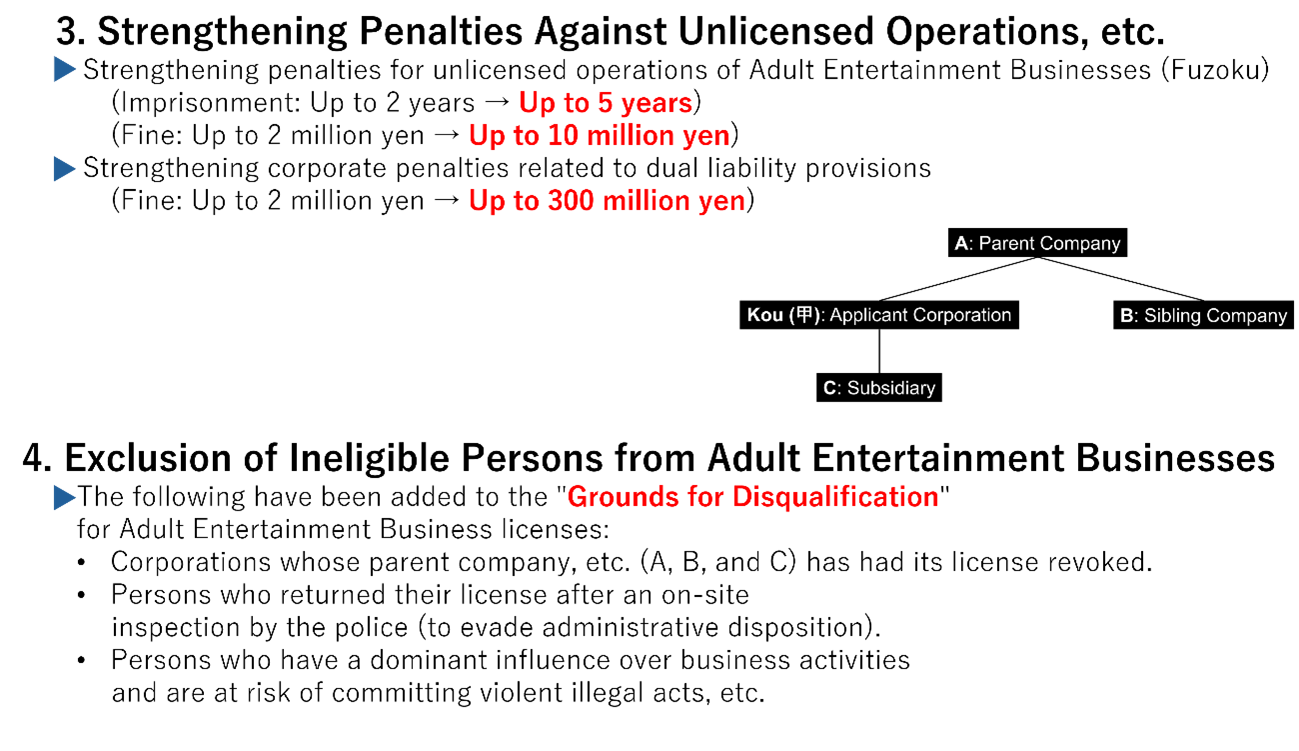
(Source: National Police Agency, "Overview of the Act to Partially Amend the Act on Control and Improvement of Amusement Business, etc. (Act No. 45 of 2025)" https://www.npa.go.jp/laws/kaisei/houritsu.html)
【Strengthening Penalties for Unlicensed Operation, etc.】
Previously, unlicensed operation was already subject to punishment. However, amusement businesses, particularly ‘’entertaining and food and drink-serving business’’, can generate high revenues even in a short period. Because the revenue returns were often greater than the risks of being cracked down upon, unlicensed operations persisted. Furthermore, unlicensed operation by members of organized crime groups (Yakuza), who cannot obtain an amusement business license, has been a problem as it serves as a source of funding for such groups.
In recent years, there have been several cases where Yakuza members operated store based sex-related businesses under the guise of "Men's Esthetics" in apartments located in prohibited zones for Sex-Related Businesses. These illegal operations were also identified as funding sources for organized crime.
Against this background, and with reference to penalties for unlicensed industrial waste disposal under the Act on Waste Management and Public Cleaning, the amended law has raised the statutory penalty to imprisonment for up to 5 years or a fine of up to 10 million yen, or both. Additionally, while "dual liability provisions" (punishing both the actual violator and the corporation/individual employer) existed previously, there was no difference in the fine amounts for corporations and individuals. Corporate operations tend to be larger and more profitable than individual ones, and a fine of 2 million yen was deemed an insufficient deterrent. Thus, following the model of the Waste Management Act, the fine for corporations was significantly increased.
【Corporations whose Parent Company, etc., had its License Revoked】
In the amusement business, multiple corporations often form a "group," where a "main corporation" has its closely related affiliates obtain licenses. The main corporation may control these affiliates by sending its officers to act as employees of the affiliates to determine management policies or by entering consulting contracts.
Previously, if one shop in a group had its license revoked, there was no mechanism to restrict other shops in the same group. This allowed owners to evade the intent of Article 4, Paragraph 1, Item 6 of the Act—which prohibits those whose license was revoked for legal violations from conducting amusement business for five years—by exercising influence over related corporations. This amendment aims to prevent such evasion.
【Persons who Returned Licenses (Evading Sanction) After Police Inspection】
The Public Safety Commission has previously prohibited the insurance of licenses for a period of five years to those who returned their license (except for justifiable reasons) between the date of public notice for a hearing and the date of the final decision on revocation, to the corporation that ceased to exist due to merger or surrendered its license during the relevant period (excluding those with valid reasons for the merger or cessation of adult entertainment business operations) and individuals who were officers of such corporatios, or to the corporation that succeeded the amusement business subject to the hearing or succeeded the other amusement businesses other than the one subject to the hearing, through a split(except where there are reasonable grounds for the split) individuals who were officers of such corporatios. However, those who returned their license before that specific period (e.g., immediately after an inspection but before the formal hearing notice) were not covered by the disqualification criteria.
This allowed operators to foresee a license revocation after an inspection uncovered violations and return their license early to avoid being disqualified from future business. This amendment was made to prevent such "sanction evasion".
【Persons whose Business Activities are Under the Dominant Influence of Violent Unlawful Act Performers】
While licenses cannot be granted to corporations with officers who fall under the disqualification criteria, the term "officer" previously referred to those holding a specific title. Those without a title were not considered "officers" even if they held dominant influence over the corporation.
Consequently, there were cases where Yakuza executives operated businesses through relatives or associates, exercising dominant influence over them while remaining outside the legal definition of an "officer". This amendment aims to crack down on such acts where violent unlawful act performers exert dominant influence over licensed operators.
Interpretation of Provisions (Strengthening Penalties for Unlicensed Operation, etc.)
【Provisions】
| Article | Violation / Penalty |
| Article 49 | A person that falls under any of the following items is punished with imprisonment for up to 5 years or a fine of up to 10 million yen, or both. ① Operating an amusement business without the license required under Article 3, Para 1. ② Obtaining a license or approval (inheritance, merger, split) through deception or other improper means. ③ Violating Article 11 (Lending of Name). ④ Violating orders of the Public Safety Commission (e.g., business suspension). ⑤ Violating Article 28, Para 1 (Operation of shop-based sexual services in prohibited zones). ⑥ Violating prefectural ordinances based on Article 28, Para 2. |
| Article 57 | If a representative of a corporation, or an agent, employee, or other worker of a corporation or individual commits a violation regarding the business, the corporation shall be fined as follows, in addition to the punishment of the actual violator. Violation of Article 49: Fine of up to 300 million yen. |
Notes on Article 49:
The target of punishment includes unlicensed operation, improper acquisition of licenses (Article 3, Para 1), inheritance (Article 7, Para 1), mergers (Article 7-2, Para 1), and splits (Article 7-3, Para 1), as well as name-lending (Article 11), violation of suspension orders (Article 26, etc.), and operation in prohibited zones (Article 28, etc.).
Attention must also be paid to the state of operation after a license is obtained. For example, if one obtains an amusement business license with the intent to operate sexual services in a prohibited zone and later modify the facilities to do so, one may be charged not only with failure to notify (Article 53) but also with improper acquisition of a license (Article 49, Item 2) and operation in a prohibited zone (Article 49, Items 5 or 6).
Furthermore, crimes under the amended Article 49 are now included as "predicate offenses" for "criminal proceeds" under the Act on Punishment of Organized Crimes and Control of Proceeds of Crime. This means assets obtained through these violations can be subject to crackdown for concealment or receipt and may be subject to confiscation.
【What is the Dual Liability Provision?】
Article 57 is a dual liability provision where not only the individual violator but also the employer (corporation or business operator) can be punished. This is based on the idea that violations are not just individual issues but also stem from a lack of supervision or systemic flaws by the employer. To hold the employers accountable for their duty of oversight, fines for corporations are often higher than those for individuals.
Theoretically, employers may escape punishment if they can prove they exercised "necessary care and supervision" to prevent the violation. However, since negligence is presumed, the employers must prove they were not negligent, and in practice, such cases are extremely limited.
- "Business Operators": Persons who manage the business on their own account. They remain liable for violations committed while they were the operator even after they cease to be the operator.
- "Employee": Anyone engaged in the business under the control and supervision of the employer, regardless of whether a formal employment contract exists.
- "Regarding the Business": Acts performed in connection with the employer's business externally, even if the employee was internally pursuing private gain.
Interpretation of Provisions (Exclusion of Unsuitable Persons from Amusement Businesses)
【Provisions】
Article 4 (Standards for License) The Public Safety Commission shall not grant a license if the person seeking the license falls under any of the following items:
- Item 7 (Closely Related Corporations): If a corporation (including parent, sibling, or subsidiary company) closely related to the applicant has had its license revoked under Article 26, Para 1, and five years have not passed since the revocation.
- Item 8 (Evading Sanction after Inspection): If a person returned his/her license within five years after an inspection was conducted (Article 37, Para 2) up until the "Scheduled Date for Hearing Decision" (notified within 10 days of the inspection and set within 90 days).
- Item 9 (Officers of the above): Officers of corporations that were dissolved or returned their license during the periods mentioned in Item 8, who held office within 60 days prior to the public notice or inspection.
- Item 13 (Persons under dominant influence): Persons whose business activities are under the dominant influence of those falling under Item 3 (violent unlawful act performers, etc.) through investment, loans, transactions, or other relationships.
【Item 7: Closely Related Corporations】
This Item provides that if a corporation having a close relationship with an applicant has had its amusement business license revoked, the said applicant shall be unable to obtain an amusement business license until five years have passed from the date of the said revocation.
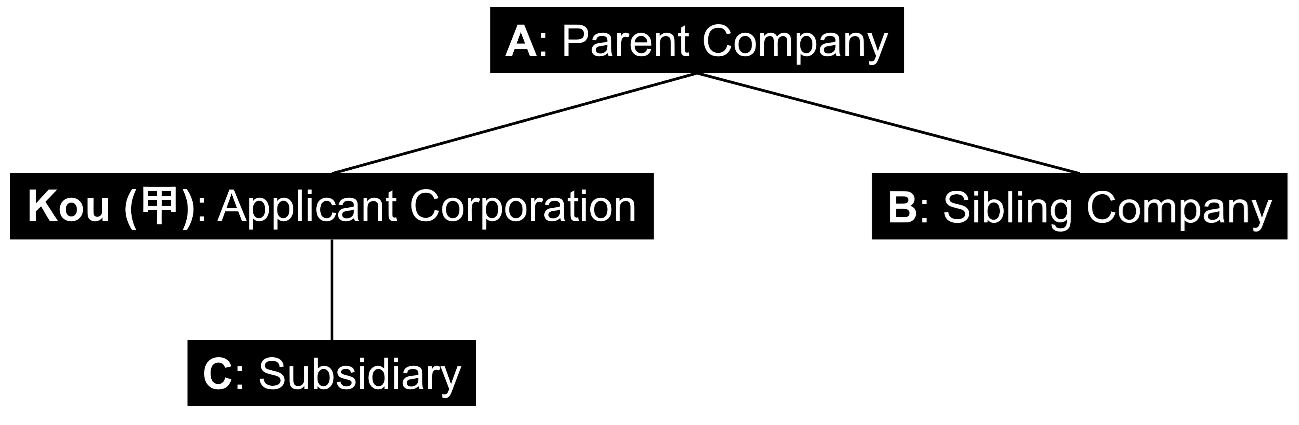
Points (a) through (c) of this Item correspond respectively to the following in the diagram above:
- (a): A (Parent Company)
- (b): B (Sibling Company)
- (c): C (Subsidiary)
In conjunction with the amendment of this item, regarding the parts stating "prescribed by the Rules of the National Public Safety Commission" for the criteria falling under (a) through (c), partial amendments were made and prescribed in the Enforcement Rules of the Act on Control and Improvement of Amusement Business, etc. (effective November 28, 2025).
Article 6-3 (Corporations having a close relationship with the person seeking a license)
|
In this way, as criteria for falling under the category of "having a relationship that substantially controls the business or exerts significant influence on the business" in Article 4, Item 7 of the amended Act, Items 1 and 2 of each paragraph of Article 6-3 of the Rules prescribe that cases where share ownership or capital contribution exceeds a majority shall apply, while Item 3 of each paragraph of the same Article prescribes that cases where there is a "close relationship" shall apply.
In determining whether a "close relationship" exists, factors such as the history of how the relationship was formed, the content of the current relationship status, past exercise of voting rights, and similarity in trade names will be considered. For example:
- A corporation that dispatches persons who are or were its officers or employees as representative officers of another corporation.
- A corporation that provides loans (including debt guarantees and provision of collateral) for a substantial portion of the total funding raised by another corporation.
- A corporation that has entered a technical assistance contract, the termination of which would have a significant impact on the continuity of the business.
- A corporation that exerts a significant impact on business operations through a franchise agreement, etc.
These are generally considered to be persons with a "close relationship." Furthermore, the determination will be made by comprehensively considering the relationship between corporations, including cases where a person holds a significant number of voting rights (even if not a majority) or influences the determination of business policies through the distribution of service or management manuals, or the guidance and education of officers and employees.
【Item 8: Persons who Returned a License (Evading Sanction) After a Police Inspection】
This Item provides that if a license is returned between the date an inspection was conducted and the "Scheduled Date for Hearing Decision," the person who returned the license and its officers shall be unable to obtain an amusement business license for five years from the date of the said return. Following this amendment, the "Scheduled Date for Hearing Decision" prescribed in (b) of this Item (discussed below) was defined by a partial amendment to the Enforcement Rules as follows (effective date same as above):
Article 6-4 (Notification of the Scheduled Date for Hearing Decision to Amusement Business Operators)
|
Regarding the "Scheduled Date for Hearing Decision" prescribed in Article 4, Paragraph 1, Item 8 (b) of the amended Act:
(a) Under Article 6-4, Paragraph 1 of the Enforcement Rules, it is to be a specific date within 90 days of the inspection. However, the scheduled date does not necessarily have to coincide with the actual date of the hearing; rather, the date on which it is expected that a decision on the necessity of a hearing will be made at the time of the inspection shall be notified as the scheduled date.
(b) The notification of the scheduled date shall be given when there is a possibility of a revocation order under Article 26, Paragraph 1 of the Act, in light of the disposition standards under Article 26, Paragraph 1 as specified in "Revision of Models for Examination Standards, etc. (Notification)" (Police Agency Bo-Hatsu No. 15, dated October 17, 2025).
(c) Notification of the scheduled date does not necessarily need to be in writing and may be given orally. However, even if given orally, a "Written Notice of Scheduled Date for Hearing Decision" must be issued based on Paragraph 2 of the same Article.
(d) If there is a "justifiable reason" for the abolition of the amusement business, it shall not fall under the disqualification criteria of Article 4, Paragraph 1, Item 8. A "justifiable reason" refers to, for example, cases where the closure of the business was planned before the inspection was conducted and employees had been informed of this prior to the inspection. The burden of proof for such reasons lies with the person who closed the business.
【Item 9: Disqualification Criteria Related to Mergers】
The purpose of Article 4, Paragraph 1, Item 9 of the amended Act is to prevent the officers of a corporation from using a merger as a means to avoid falling under the disqualification criteria for an amusement business license (Article 4, Paragraph 1, Item 6) resulting from a license revocation under Article 26, Paragraph 1. Such officers shall be considered disqualified for five years from the date the corporation ceased to exist due to the merger. Targeting those who were "officers within 60 days prior to the date of public notice mentioned in (a) of the preceding item" or "officers within 60 days prior to the date of inspection mentioned in (b) of the preceding item" is because such persons are highly likely to have been involved in the decision-making process to execute the merger. Note that mergers with "justifiable reasons" do not fall under this disqualification ground. "Justifiable reasons" refers to, for example, cases where the cause for the hearing regarding the license revocation under Article 26, Paragraph 1 occurred after the internal decision to merge had already been made.
【Item 10: Disqualification Criteria Related to Company Splits】
The purpose of Article 4, Paragraph 1, Item 10 of the amended Act is to ensure that a corporation and its officers who attempt to use a company split to avoid the disqualification criteria (Article 4, Paragraph 1, Item 6) resulting from a license revocation under Article 26, Paragraph 1 shall be considered disqualified for five years from the date of the split. The corporations that become disqualified for five years from the date of the split under this item are:
① A corporation that, through a split, transferred the amusement business subject to the hearing under Article 4, Paragraph 1, Item 8 (a).
② A corporation that, through a split, succeeded to an amusement business other than the one subject to the hearing under Article 4, Paragraph 1, Item 8 (a).
③ A corporation that, through a split, transferred the amusement business subject to the inspection under Article 4, Paragraph 1, Item 8 (b).
④ A corporation that, through a split, succeeded to an amusement business other than the one subject to the inspection under Article 4, Paragraph 1, Item 8 (b).
For example, if Corporation A operates Shop X and Shop Y, and a cause for a hearing arises regarding Shop X: if Corporation A executes a split to transfer Shop X to another entity (Corporation B), Corporation A falls under ①. Conversely, if Corporation A keeps Shop X and transfers Shop Y to Corporation B, Corporation B falls under ②. The same logic applies to inspections (falling under ③ and ④ respectively). In essence, among the corporations involved in a split to evade administrative sanctions, those that would otherwise avoid the hearing will fall under the disqualification criteria of this item. In such cases, at the time the application for approval of the split is made, the effect of the split has not yet occurred, so it does not fall under the disqualification criteria of this item, and approval will be granted unless other disqualification criteria apply. However, on the day the split takes effect and the succession of the status of amusement business operator occurs as a result of the approval, it will automatically fall under the disqualification criteria of this item and become subject to license revocation under Article 8, Item 2.
Officers who become disqualified for five years from the date of the split are those who were officers of corporation ① or ② within 60 days prior to the public notice of the hearing date/place, or officers of corporation ③ or ④ within 60 days prior to the inspection under Article 37, Paragraph 2. Company splits with "justifiable reasons" (e.g., the cause for revocation arose after the internal decision to split) are excluded from these disqualification criteria.
【Item 13: Persons under the Dominant Influence of Violent Unlawful Act Performers】
This Item provides that an amusement business license must not be granted if a person who has dominant influence over the business activities of an individual or a corporation seeking the license (even if that person holds no formal title in the corporation) falls under the category of a "violent unlawful act performer." A "person falling under Item 3" (a violent unlawful act performer) refers to a person for whom there are reasonable criteria to find they are likely to collectively or habitually perform violent unlawful acts or other crimes as prescribed by the Rules of the National Safety Commission. Specifically, this includes:
- Organized crime group members (Yakuza members) as defined in Article 2, Item 6 of the Act on Prevention of Unjust Acts by Organized Crime Group Members.
- Persons for whom five years have not passed since they ceased to be Yakuza members.
- Members of criminal organizations other than Yakuza who are recognized as having a strong propensity to commit crimes based on the nature of the organization (crime rate, recidivism, etc.).
- Persons who have performed violent unlawful acts (Article 6 of the Enforcement Rules) within the past 10 years and are recognized as having a strong propensity to commit crimes based on their motive, background, means, and daily conduct.
In determining the applicability of this item, the relationship between the applicant's business activities and the violent unlawful act performer will be examined on a case-by-case basis. The scope of persons having "dominant influence" under this item is generally interpreted to be broader than that of "dominance" under Item 6 of the same paragraph. For example, it could apply to someone with no formal position in a corporation if they provide large-scale investment/loans (in their own name or another's) or have significant transactional relationships, thereby exerting dominant influence. Furthermore, "other relationships" include various ties such as family, human capital, and shareholding. For example:
- Cases where a relative (including by de facto marriage) of a violent unlawful act performer, or a person closely related to a Yakuza or violent unlawful act performer, is the individual business operator or an officer of a corporate operator, and the performer exerts dominant influence through large shareholdings, etc.
- Cases where a performer is recognized as having dominant influence over business activities due to the provision of large sums of money or other property benefits, or the existence of large-scale service contracts (sales, construction, delegation, etc.), regardless of the nominal reason. This disqualification criteria applies to both corporate and individual operators.
【Attached Documents for Application】
Accompanying this amendment, the following changes were made to the documents to be submitted at the time of application:
- A written oath stating that the applicant does not fall under any of the persons listed in Article 4, Paragraph 1, Item 7 and Item 13 of the amended Act.
- If there is a corporation listed in Article 4, Paragraph 1, Item 7 (a) to (c) that has a close relationship with the applicant, a document stating its name, address, and the name of its representative.
- If the applicant is a stock company, a copy of the shareholder register.
(Note) Public comment results for this point have been published: National Police Agency, October 17, 2025: "Results of Public Comments on the 'Draft Cabinet Office Ordinance Partially Amending the Cabinet Office Ordinance Concerning Attached Documents for Application for License Based on the Act on Control and Improvement of Amusement Business, etc.'" https://public-comment.e-gov.go.jp/servlet/Public?CLASSNAME=PCM1040&id=120250021&Mode=1
Matters for Business Operators to Note
With this amendment, penalties for unlicensed operation have been strengthened and statutory fines raised. However, it is also crucial to understand this "strictness" in the context of the Act on Punishment of Organized Crimes, as these violations are now predicate offenses for the confiscation and collection of criminal proceeds under the related provisions.
Additionally, the introduction of a "Management Group" (enterprise body) perspective means that if one corporation within a group has its license revoked, the entire group may be affected "in the same boat" (Article 8, Item 2). Previously, multiple corporations were sometimes established to isolate the impact of administrative sanctions, but this amendment may affect such organizational strategies. Business operators are advised to accurately identify their group structure, separate "closely related corporations," and continuously ensure that all entities remain compliant.
Even if there were no issues at the time of establishment, changes in circumstances thereafter could put the business license at risk. Especially regarding businesses providing service with amusement, as the scope of regulated acts has expanded (as introduced in blogs 1 through 3), it is important from the perspective of corporate compliance and crisis management to re-examine the current status of your company and respond appropriately.
END
Reference Materials:
- National Police Agency, Oct 20, 2025 (Police Agency Bo-Hatsu No. 14, etc.): "Standards for Interpretation and Implementation of the Act on Control and Improvement of Amusement Business, etc. (Notice)" https://www.npa.go.jp/laws/notification/seian/hoan/hoantsutatu2/R071017hueikaisyaku.pdf
- National Police Agency, Oct 17, 2025 (Tei-Bo-Hatsu No. 196, etc.): "Promulgation of the Cabinet Office Ordinance Partially Amending the Cabinet Office Ordinance Concerning Attached Documents for Application for License Based on the Act on Control and Improvement of Amusement Business, etc. (Notification)" https://www.npa.go.jp/laws/notification/seian/hoan/hoantsutatu2/R071017hueihureikisokukouhu.pdf
- Keisatsugaku Ronshu (The Journal of Police Science) Vol. 78, No. 12: "Partial Amendment of the Act on Control and Improvement of Amusement Business, etc. in 2025—Background, Progress, and Status of Deliberations" by Shigeomi Higaki (Former Director General, Life Safety Bureau, NPA); "Act to Partially Amend the Act on Control and Improvement of Amusement Business, etc." by Yuta Kimura (Former Assistant Director, Safety Division, Life Safety Bureau, NPA), et al.
Note: This blog is intended for general information purposes and does not constitute legal advice from this firm. Furthermore, the views expressed in this blog are the personal views of the authors and do not represent the views of this firm. If you have any questions regarding specific cases or this amended act, please consult with a lawyer at our firm.
Member


SHARE