
ブログ
Japan Revises Trademark Registration Requirements for Trademarks Containing Another Person’s Name: Overview of the Amendment and Recent Examination Practice — Amendment to Article 4(1)(viii) of the Trademark Act —
2026.07.10
SHARE


Introduction
The amended Trademark Act, which came into effect on April 1, 2024, revised the scope of Article 4(1)(viii) of the Trademark Act, which concerns trademarks containing another person’s name or similar elements.
Under the previous Trademark Act, a trademark containing another person’s name could not be registered unless the consent of that person had been obtained. While this provision played an important role in protecting personal interests in one’s name, it had also been pointed out in practice that even a trademark containing the brand owner’s own name could potentially be refused registration if there was a third party with the same name.
This issue was particularly significant for fashion brands and designer brands, which often use the names of their founders or designers as brand names. The inability to register such marks presented a serious issue from the perspective of brand protection.
Against this background, Article 4(1)(viii) was revised and new registration requirements were introduced, with a view to striking an appropriate balance between maintaining the protection of personal interests in one’s name and ensuring brand protection.
This article provides an overview of the amendment, explains the newly introduced registration requirements, and introduces examples of trademarks containing another person’s name that have been registered or refused under the amended Trademark Act.
Overview of the Amendment
Under the amended Article 4(1)(viii) of the Trademark Act, trademarks containing another person’s name may now be registered in certain circumstances.
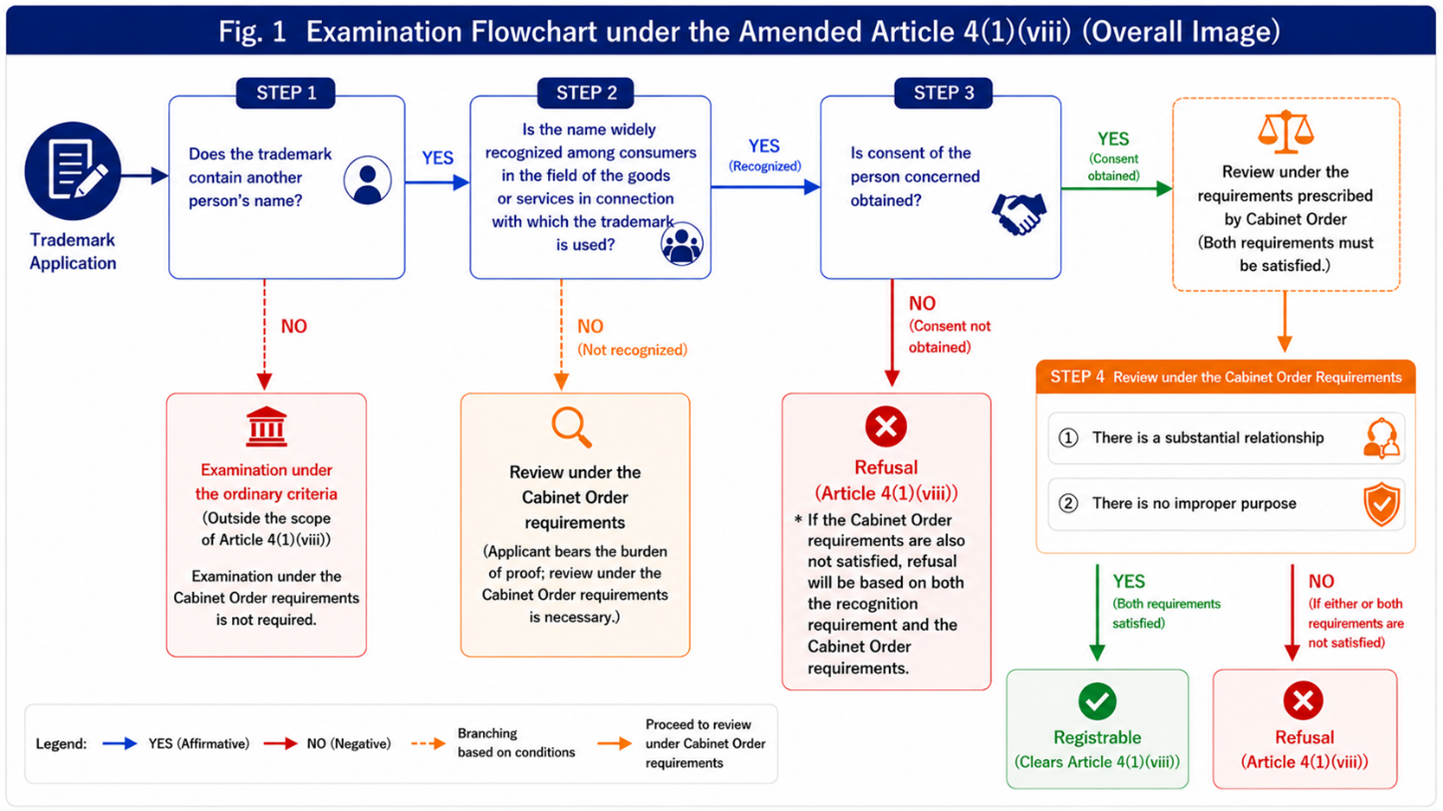
More specifically, the amendment introduces two new criteria for determining whether such a trademark may be registered: (i) whether the name is widely recognized among consumers in the field of the goods or services in connection with which the trademark is used; and (ii) whether the requirements prescribed by Cabinet Order are satisfied.
The amendment preserves the original legislative purpose of protecting personal interests in one’s name while promoting greater brand protection by facilitating the registration of trademarks containing names that satisfy these requirements.
A Name Widely Recognized Among Consumers
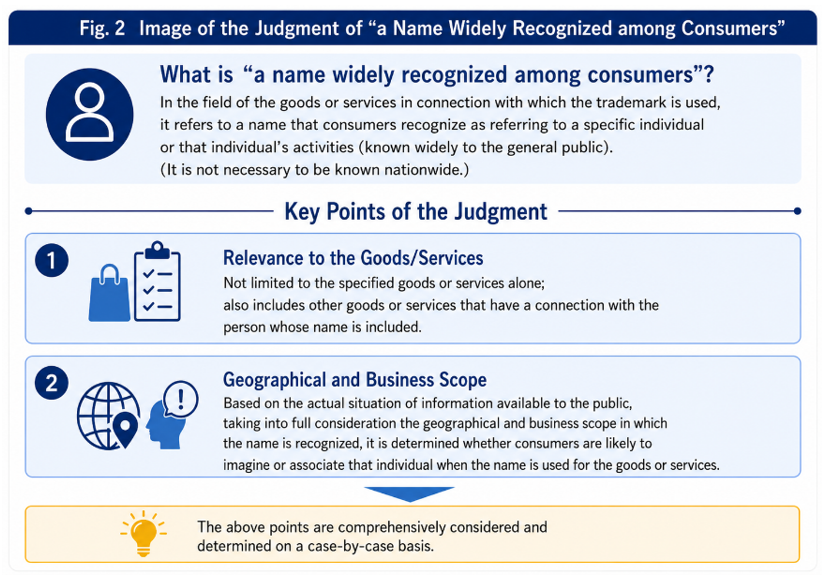
First, the amended Article 4(1)(viii) of the Trademark Act introduces a new requirement as to whether another person’s name is widely recognized among consumers in the field of the goods or services in connection with which the trademark is used.
Under the previous Trademark Act, the consent of another person was required in all cases where a trademark contained that person’s name. Under the amended Act, however, the requirement has been relaxed so that consent is required only where the name is widely recognized among consumers in the field of the goods or services in connection with which the trademark is used. In other words, even if there is another person with the same name, the applicant is no longer required to obtain that person’s consent unless the name is widely recognized within the relevant field.
According to the Trademark Examination Guidelines, in determining the “field of the goods or services in connection with which the trademark is used,” consideration should be given, from the perspective of protecting personal interests in one’s name, not only to the designated goods or services covered by the trademark application but also to goods or services that are related to the person whose name is included in the trademark.
In addition, when determining whether a name is “widely recognized among consumers,” the Guidelines provide that, from the perspective of protecting personal interests in one’s name, due consideration should be given to the geographical and business scope within which the person’s name is recognized, with particular attention to whether consumers would associate or identify the relevant person when the name is used in connection with the relevant goods or services. However, nationwide recognition is not required.
Based on the above approach, the Trademark Examination Manual provide the following example of a name that is considered to be “widely recognized among consumers in the field of the goods or services in connection with which the trademark is used.”
<Example>
Mr. Shōhyō Tarō is a fashion designer whose apparel brand, “Shōhyō Tarō,” operates flagship stores in major cities throughout Japan and also sells clothing through stores located in several department stores. In addition, his latest collections have been presented at international fashion shows overseas. Assume that a third party who has no relationship with Mr. Shōhyō Tarō and has not obtained his consent files the following trademark application:
- Trademark: “Shōhyō Tarō”
- Designated goods: Footwear; bags and pouches
Trademark Examination Manual’ Analysis
In this example, Mr. Shōhyō Tarō is considered to be widely recognized among consumers in relation to clothing. Furthermore, where clothing is closely related to the designated goods, namely footwear and bags and pouches, consumers in the relevant market are likely to associate the applicant’s trademark with Mr. Shōhyō Tarō, even if he does not manufacture or sell those designated goods himself. Accordingly, the trademark falls within the scope of Article 4(1)(viii) of the Trademark Act.
It should also be noted that, under the examination practice of the Japan Patent Office (the “JPO”), written consent from the relevant person may be submitted proactively at the time of filing or before an Office Action is issued, rather than only after an Office Action has been issued.
In addition, where the name concerned is that of a foreign individual, omission of a middle name continues to be treated as an abbreviation of the person’s name under Article 4(1)(viii), as under the previous practice. Accordingly, such abbreviated names constitute grounds for refusal only if they are well known.
Requirements Prescribed by the Cabinet Order
As discussed above, under amended Article 4(1)(viii) of the Trademark Act, the JPO examines not only whether the trademark contains the name of another person who is widely recognized among consumers in the field of the goods or services in connection with which the trademark is used, but also whether the requirements prescribed by the Cabinet Order are satisfied.
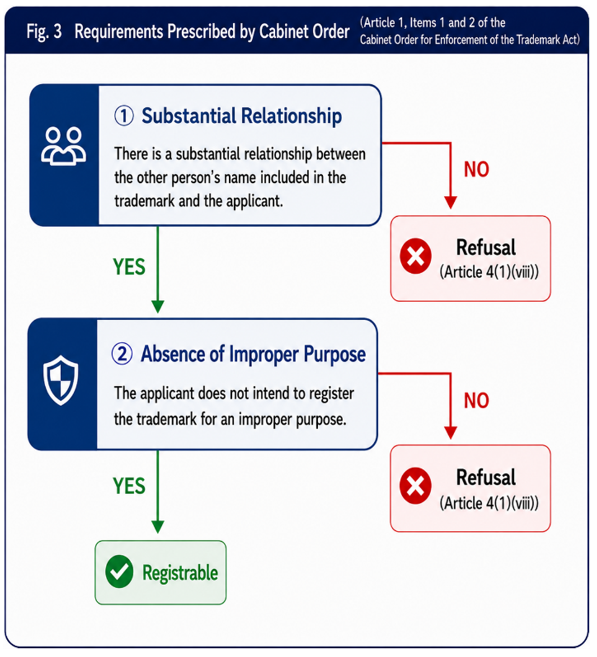
The Cabinet Order sets forth the following two requirements:
- There must be a substantial relationship between the person whose name is contained in the trademark and the applicant for trademark registration.
- The applicant must not seek to obtain trademark registration for an improper purpose.
These requirements were introduced because, while the amendment relaxes the registration requirements for trademarks containing another person’s name by limiting the consent requirement to names that have attained a certain level of recognition, simply introducing a recognition threshold and allowing registration of all trademarks containing names that do not satisfy that threshold could encourage abusive trademark filings.
In particular, there was concern that applications might be filed by persons having no connection with the individual whose name is included in the trademark or by applicants acting for improper purposes. The Cabinet Order requirements were therefore introduced to prevent such abusive filings. Each of these requirements is explained below.
(1) Substantial Relationship
Whether a substantial relationship exists is determined by comprehensively taking into account the relationship between the trademark applicant and the person whose name is included in the trademark.
For example, the Trademark Examination Guidelines provide that a substantial relationship is recognized where the applicant is the person whose name is included in the trademark. A substantial relationship is also recognized where the name is that of the founder or representative of the applicant, or where it has been continuously used as the name of a store or business prior to the filing of the trademark application.
On the other hand, a substantial relationship is not recognized where it is evident that the inclusion of another person’s name in the trademark is merely the result of the applicant’s arbitrary choice, or where the name belongs to an acquaintance of the applicant and it is evident that the relationship is merely a private one.
Where the examiner determines that a substantial relationship has not been established, the examiner will issue an Office Action, and the applicant will have an opportunity to demonstrate that such a substantial relationship exists.
(2) Absence of an Improper Purpose
According to the Trademark Examination Guidelines, an improper purpose includes circumstances where the applicant seeks to harass another person or intends to obtain payment by filing the trademark application ahead of the legitimate user and subsequently demanding that the trademark be purchased.
Whether an improper purpose exists is determined by the examiner based on publicly available information as well as information submitted through the Information Submission System, under which any person may submit information asserting that a trademark application should not be registered.
Where the examiner determines that the applicant has filed the application for an improper purpose, the examiner will issue an Office Action, and the applicant will have an opportunity to demonstrate that no such improper purpose exists.
(3) Relationship Between the Consent of the Person Concerned and the Cabinet Order Requirements
Where the consent of the person whose name is contained in the trademark has been obtained, does this automatically mean that the Cabinet Order requirements are satisfied? The JPO distinguishes between the two Cabinet Order requirements—namely, a substantial relationship and the absence of an improper purpose.
With respect to the requirement of a substantial relationship, the issue is whether a substantial relationship exists between the applicant and the person whose name is included in the trademark. Accordingly, even if the applicant has obtained the consent of that person, such consent alone does not automatically establish a substantial relationship. Rather, the existence of a substantial relationship is determined based on the consent together with any other supporting evidence submitted by the applicant.
By contrast, with respect to the requirement of the absence of an improper purpose, the JPO presumes that no improper purpose exists where the consent of the person concerned has been obtained.
Examination Practice Following the Amendment
It is also instructive to examine how the JPO has applied the amended provision in practice.
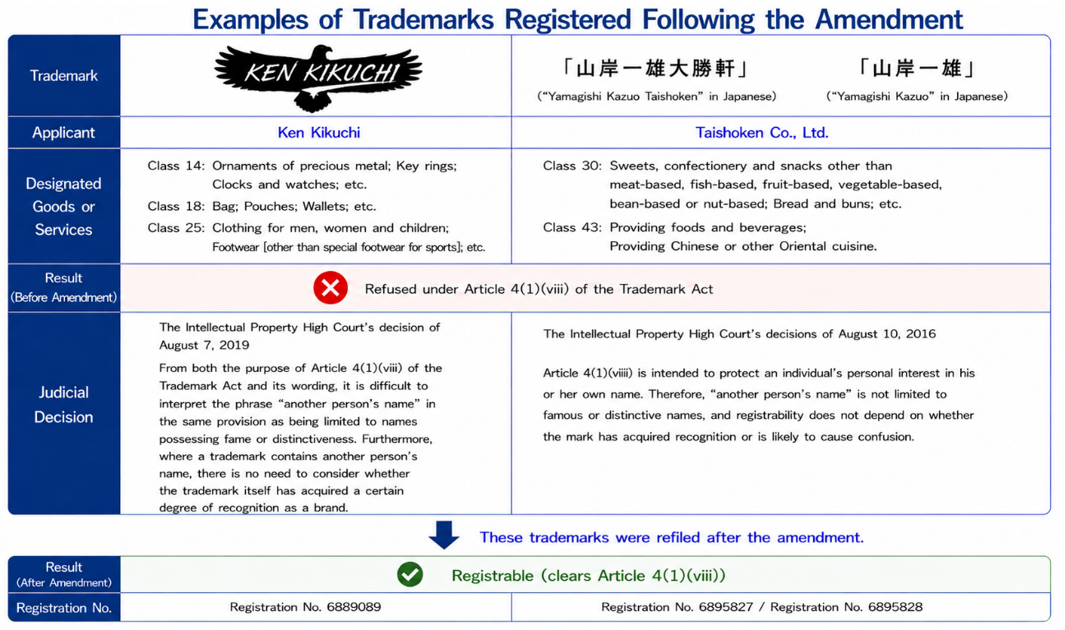
As shown in the above table, the trademarks “KEN KIKUCHI,” “山岸一雄大勝軒(“Yamagishi Kazuo Taishoken” in Japanese),” and “山岸一雄(“Yamagishi Kazuo” in Japanese)”(where “Yamagishi Kazuo” constitutes the other person’s name) were all originally filed before the amendment and were refused. Following the amendment, however, new applications were filed for each of these marks, and all of them proceeded to registration without the issuance of an Office Action.
Before the amendment, each applicant challenged the refusal all the way to the Intellectual Property High Court. The Court held that, once a trademark contained another person’s name, it fell within the scope of Article 4(1)(viii) regardless of whether that person’s name was well known, and therefore could not be registered unless the consent of that person had been obtained.
As discussed above, however, the amendment changed this framework by requiring consent only where another person whose name is widely recognized in the relevant field of the goods or services exists. Accordingly, the issue identified by the Court under the previous law no longer arose after the amendment.
As also explained above, registration under the amended provision additionally requires that (i) there be a substantial relationship and (ii) the application not be made for an improper purpose. In the case of “KEN KIKUCHI,” although the applicant did not submit any explanation specifically addressing these two requirements, the applicant himself was Mr. Ken Kikuchi. It therefore appears that the JPO naturally concluded that both requirements were satisfied.
By contrast, in the cases of “山岸一雄大勝軒(“Yamagishi Kazuo Taishoken” in Japanese),” and “山岸一雄(“Yamagishi Kazuo” in Japanese)”, the applicant was Taishoken Co., Ltd., rather than Mr. Yamagishi Kazuo himself. However, because Mr. Yamagishi Kazuo was the founder of the ramen restaurant “Taishoken,” and the applicant submitted a petition stating that it had obtained Mr. Yamagishi’s consent to file trademarks containing his name, it can be understood that the JPO found that both the substantial relationship requirement and the absence of an improper purpose requirement had been satisfied.
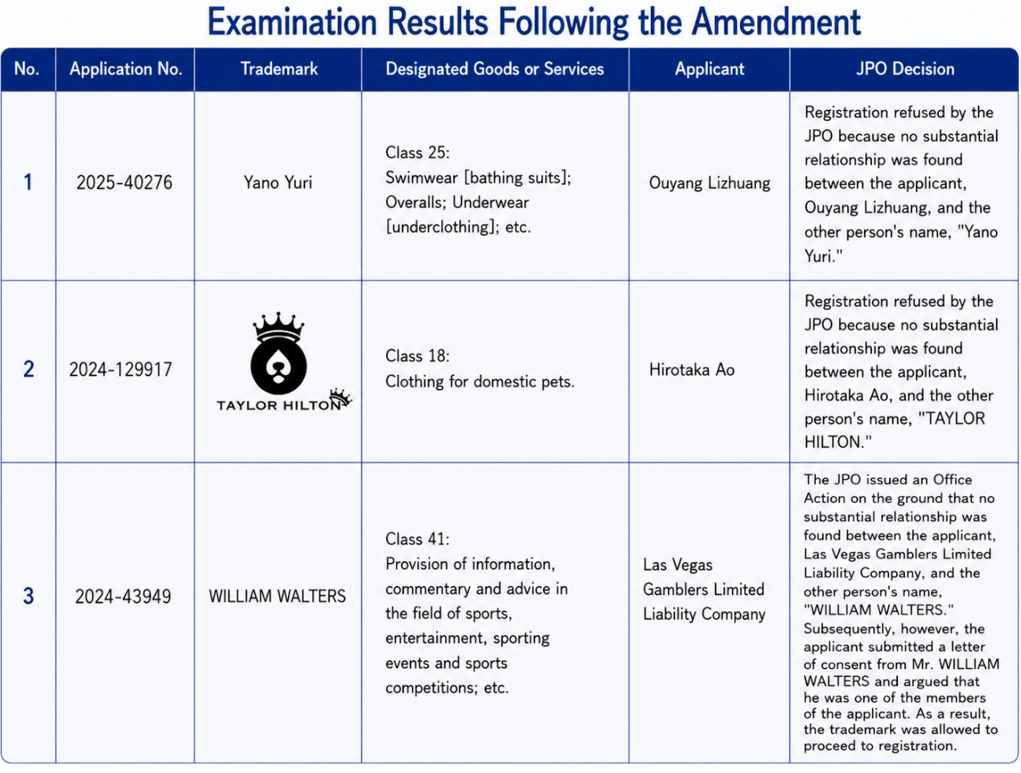
By contrast, there have also been cases in which the JPO issued an Office Action under the amended provision.
The first example shown in the above table, “Yano Yuri,” was considered to constitute another person’s name. Because the applicant was the Chinese individual “Ouyang Lizhuang,” the JPO found that no substantial relationship existed between the applicant, “Ouyang Lizhuang,” and that name. Accordingly, the JPO issued an Office Action on the ground that the application fell within the scope of Article 4(1)(viii). However, because the applicant did not submit any response to the JPO, the application was ultimately refused.
The second trademark shown in the above table consists of a device mark together with the wording “TAYLOR HILTON.” The wording was considered to constitute another person’s name, and the JPO found that no substantial relationship existed between the applicant, “Hirotaka Ao,” and that name. Accordingly, the JPO issued an Office Action on the ground that the application fell within the scope of Article 4(1)(viii). However, because the applicant did not submit any response to the JPO, the application was ultimately refused.
The same issue also arose in the bottom example shown in the above table, “WILLIAM WALTERS.” The JPO issued an Office Action on the ground that no substantial relationship existed between the applicant, “Las Vegas Gamblers Limited Liability Company,” and “WILLIAM WALTERS.” In response, however, the applicant submitted a letter of consent confirming that Mr. WILLIAM WALTERS had consented to the applicant’s registration of the trademark in Japan. In its Written Opinion, the applicant also argued that Mr. WILLIAM WALTERS was one of the members of the applicant. As a result, the JPO accepted these arguments, and the trademark proceeded to registration.
As a result of the amendment, a new requirement has been introduced that another person’s name must be widely recognized among consumers in the field of the goods or services in connection with which the trademark is used. Because relatively few individuals are likely to satisfy this level of recognition, this requirement will generally not present a significant obstacle to registration. By contrast, as illustrated in the above table, applicants should be aware that an application may still be refused unless they are able to adequately demonstrate the existence of a substantial relationship between themselves and the other person whose name is included in the trademark.
Conclusion
The amendment represents a significant step forward from the perspective of brand protection by making it easier to obtain trademark registration in cases where a person’s own name is used as a brand name. As discussed above, there are already examples of trademarks that had been refused registration before the amendment but were subsequently refiled and registered after the amendment.
Although the JPO has clarified its examination criteria and examination practice to a certain extent, disputes are likely to arise regarding the application of the new requirements in individual cases, including whether a name is “widely recognized among consumers in the field of the goods or services in connection with which the trademark is used,” and whether the Cabinet Order requirements—namely, the existence of a substantial relationship and the absence of an improper purpose—have been satisfied.
It will therefore be necessary to await the accumulation of future appeal decisions and court decisions to see how these issues develop in practice.
Member
PROFILE

SHARE