
ブログ
[Amendments to the Medical Care Act] Series: The 2025 Medical Care Act Amendments and the Regulation of Telemedicine – Part 1: The Evolution of the Regulatory Framework Governing Telemedicine and the Background to the Amendments
2026.08.17
SHARE


Introduction
On April 1, 2026, the provisions relating to telemedicine under the Act Partially Amending the Medical Care Act and Other Acts (Act No. 87 of 2025, the "Amending Act") came into force. The amendments mark the first time that telemedicine has been expressly defined under the Medical Care Act, elevating its legal basis from guidance and administrative notices governing its interpretation and implementation to statutory law. In this five-part series, we examine the key aspects of the amendments.This first article reviews the evolution of Japan's regulatory framework for telemedicine and the background that led to the amendments.
Definition of Telemedicine
Before examining the Amending Act, it is helpful to clarify several key terms.
Under Article 2-2(1) of the Medical Care Act, "telemedicine" means medical treatment provided through a method that enables a physician or dentist and a remotely located patient to communicate by transmitting and receiving video and audio via telecommunications lines connecting the computers used by each party, while mutually recognizing each other's condition. In practice, this refers to medical consultations conducted by video call.
Telemedicine is one form of the broader concept of "remote healthcare," which encompasses healthcare-related activities, including health promotion and medical care, that utilize information and communications technology (ICT). It is also distinguished from medical consultations conducted solely through the exchange of text messages, photographs, or pre-recorded videos, such as consultations by email or chat.
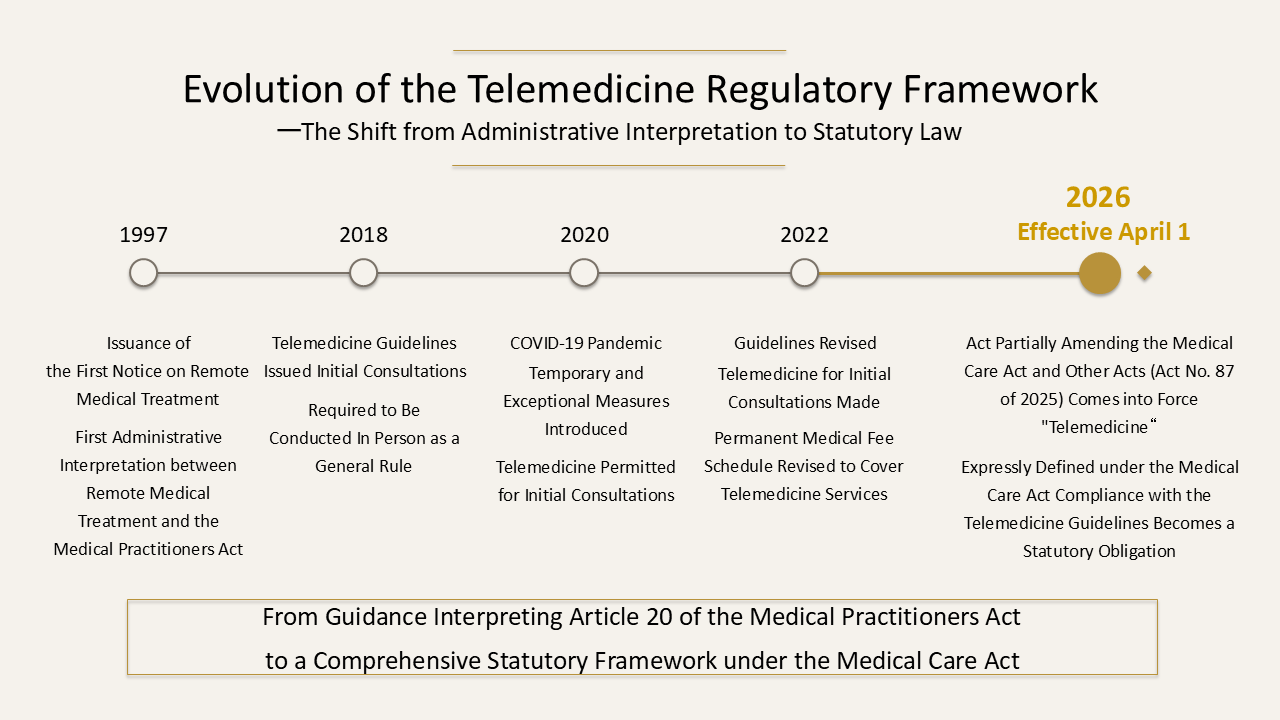
Evolution of the Regulatory Framework—From Administrative Interpretation to Statutory Law
The regulatory framework governing telemedicine has evolved into a complex regime involving the interaction of two separate statutes: the Medical Practitioners Act and the Medical Care Act. Historically, however, the legal discussion centered on the Medical Practitioners Act. In particular, Article 20 of the Medical Practitioners Act requires physicians to personally examine a patient before providing treatment or issuing a prescription.
|
Article 20 of the Medical Practitioners Act |
Against this backdrop, the key legal question has been whether a medical consultation conducted through information and communications technology (ICT), such as a video call rather than an in-person consultation, satisfies the requirement that the physician "personally examine" the patient. For many years, the Ministry of Health, Labour and Welfare (MHLW), as the competent regulatory authority, addressed this issue through administrative interpretation rather than legislation.
(1) 1997: The First Administrative Interpretation
In 1997, the Ministry of Health and Welfare (now the Ministry of Health, Labour and Welfare (MHLW)) issued a notice entitled "Medical Treatment Using Information and Communications Equipment (So-Called "Remote Medical Treatment")". This was the first official administrative interpretation addressing remote medical treatment (now referred to as telemedicine). The notice clarified that, provided certain requirements were satisfied, remote medical treatment would not, in itself, violate Article 20 of the Medical Practitioners Act, which prohibits treatment without a personal examination.
The following passage from the notice is particularly significant:
|
The term 'examination' as used in Article 20 of the Medical Practitioners Act and related provisions refers to medical assessment, including history-taking, visual examination, palpation, auscultation, and other methods, regardless of the means employed, to the extent that a provisional diagnosis of a disease can be made based on contemporary medical standards. Accordingly, although remote medical treatment may not be equivalent to an in-person consultation, where sufficient information concerning the patient's physical and mental condition can be obtained to serve as an adequate substitute for an in-person consultation, the provision of remote medical treatment does not, in itself, constitute a violation of Article 20 of the Medical Practitioners Act or related provisions. |
Accordingly, the Ministry clarified that, where the information available about the patient is sufficient, in light of contemporary medical standards, to enable a provisional diagnosis of the patient's condition, the consultation does not contravene Article 20 of the Medical Practitioners Act.
(2) 2018: Guidelines for the Appropriate Practice of Telemedicine
In 2018, the Ministry of Health, Labour and Welfare (MHLW) issued the "Guidelines for the Appropriate Practice of Telemedicine" (the "Guidelines") (most recently revised in April 2026). The Guidelines were established on the premise that compliance with the "minimum requirements" set out therein would generally ensure that the provision of telemedicine would not violate Article 20 of the Medical Practitioners Act.
When the Guidelines were first issued, they adopted the principle that an initial consultation should, in principle, be conducted in person. Accordingly, providing an initial consultation through telemedicine was regarded as inconsistent with Article 20 of the Medical Practitioners Act.
(3) 2020–2022: Regulatory Relaxation Triggered by the COVID-19 Pandemic
A major turning point came in 2020 with the outbreak of the COVID-19 pandemic.
As a temporary and exceptional measure, the Ministry of Health, Labour and Welfare (MHLW) permitted telemedicine for initial consultations (Administrative Notice dated April 10, 2020).
Based on the experience gained under this temporary framework and the practical implementation of telemedicine during the pandemic, the regulatory framework was further relaxed in 2022. Specifically, the 2022 revision to the Guidelines made it possible, on a permanent basis, to provide telemedicine from the initial consultation. In addition, the 2022 revision of the national medical fee schedule introduced reimbursement categories for both initial and follow-up consultations conducted through telemedicine.
Background to the Amendments—Emerging Challenges
Alongside the relaxation of regulations and the expansion of telemedicine, a number of serious issues also emerged. These included inappropriate practices such as prescribing psychotropic medications following an initial telemedicine consultation, providing medical consultations solely through chat-based communication, and readily prescribing GLP-1 receptor agonists and medications for erectile dysfunction (ED) without adequate clinical assessment.
Before the 2025 amendments, neither the Medical Care Act nor the Medical Practitioners Act expressly defined "telemedicine." The Guidelines merely set out the circumstances in which compliance would generally ensure that a telemedicine consultation would not violate Article 20 of the Medical Practitioners Act. As administrative guidance rather than legislation, however, the Guidelines had limited legal force and did not provide a sufficient legal basis for administrative enforcement.
Challenges also arose from the perspective of promoting telemedicine. While telemedicine offers significant benefits in areas with limited access to medical resources, practical barriers remained, including the difficulty of securing suitable physical locations where patients could receive telemedicine consultations.
Against this backdrop, the 2025 amendments to the Medical Care Act were enacted with the dual objectives of promoting the appropriate use of telemedicine while ensuring that telemedicine is provided in an appropriate manner. The Ministry of Health, Labour and Welfare (MHLW) has explained that the purpose of the amendments is "to further promote appropriate telemedicine by establishing a comprehensive statutory framework for telemedicine under the Medical Care Act while building on the operation of the existing regulatory regime."
Key Information on the 2025 Amendments
The following is a summary of the key legislative milestones relating to the Amending Act. The Act Partially Amending the Medical Care Act and Other Acts (Act No. 87 of 2025) was approved by the Cabinet on February 14, 2025, and promulgated on December 12, 2025.
The provisions relating to telemedicine came into force on April 1, 2026. The relevant Cabinet Order (Cabinet Order No. 66 of 2026), Ministerial Ordinance (Ministry of Health, Labour and Welfare Ordinance No. 46 of 2026), and Public Notice (Ministry of Health, Labour and Welfare Public Notice No. 115 of 2026) were each promulgated on March 27, 2026, and also came into force on April 1, 2026. The Ministry of Health, Labour and Welfare (MHLW) also issued an implementation notice (Medical Affairs Bureau Director's Notice No. Isei-Hatsu 0327-5, dated March 27, 2026) providing guidance on the implementation of the amendments.
Our next article will examine the regulatory framework for telemedicine established under the Amending Act.
[Related Links]
■ Amendments to the Medical Care Act
• Act Partially Amending the Medical Care Act and Other Acts
https://www.mhlw.go.jp/content/001681278.pdf
• Cabinet Order Partially Amending the Order for Enforcement of the Medical Care Act and Related Orders
https://www.mhlw.go.jp/content/001681281.pdf
• Ministerial Ordinance Partially Amending the Regulation for Enforcement of the Medical Care Act and Related Regulations
https://www.mhlw.go.jp/content/001681282.pdf
• "Q&A on Telemedicine" (Issued in March 2026)
https://www.mhlw.go.jp/content/001681026.pdf
■ Implementation Notice
• "Partial Enforcement of the Act Partially Amending the Medical Care Act and Other Acts (Telemedicine)" (Medical Affairs Bureau Director's Notice No. Isei-Hatsu 0327-5, dated March 27, 2026)
https://www.mhlw.go.jp/content/001681277.pdf
■ Telemedicine Guidelines and Q&A (April 2026 Revision)
• Guidelines for the Appropriate Practice of Telemedicine (Revised in April 2026)
https://www.mhlw.go.jp/content/001685701.pdf
• Q&A on the Guidelines for the Appropriate Practice of Telemedicine
https://www.mhlw.go.jp/content/001686805.pdf
■ 1997 Notice
• Medical Treatment Using Information and Communications Equipment (So-Called "Remote Medical Treatment") (Health Policy Bureau Director's Notice No. 1075, dated December 24, 1997)
https://www.mhlw.go.jp/content/10800000/001233138.pdf
■ 2020 COVID-19 Temporary Special Measures (Administrative Notice of April 10, 2020)
• Temporary and Exceptional Measures for Medical Consultations by Telephone and Information and Communications Equipment in Response to the Spread of COVID-19 (Administrative Notice dated April 10, 2020)
https://www.mhlw.go.jp/content/000620995.pdf
■ Reference: MHLW "Telemedicine"
https://www.mhlw.go.jp/stf/index_0024_00004.html
Member
PROFILE

SHARE