Introduction
Part 2 of this series examined the regulatory framework introduced by the amended Medical Care Act. This article focuses on the substantive requirements of the Telemedicine Standards.
What Are the Telemedicine Standards?
The Telemedicine Standards are the legally binding standards governing the provision of telemedicine, prescribed in the Regulation for Enforcement of the Medical Care Act pursuant to Article 14-3 of the amended Medical Care Act. The Telemedicine Standards elevate certain "minimum requirements" previously set out in the Telemedicine Guidelines (an administrative notice issued by the Ministry of Health, Labour and Welfare) to the level of a ministerial ordinance. As a result, non-compliance may give rise to administrative sanctions and other regulatory measures.
Article 14-3(2) of the amended Medical Care Act provides that the Telemedicine Standards are to prescribe requirements concerning:
(1) the facilities, equipment, and staffing of hospitals and clinics providing telemedicine;
(2) the locations where patients may receive telemedicine;
(3) the information and explanations to be provided to patients;
(4) arrangements to ensure appropriate treatment where a patient's condition suddenly deteriorates; and
(5) any other matters necessary for the appropriate provision of telemedicine.
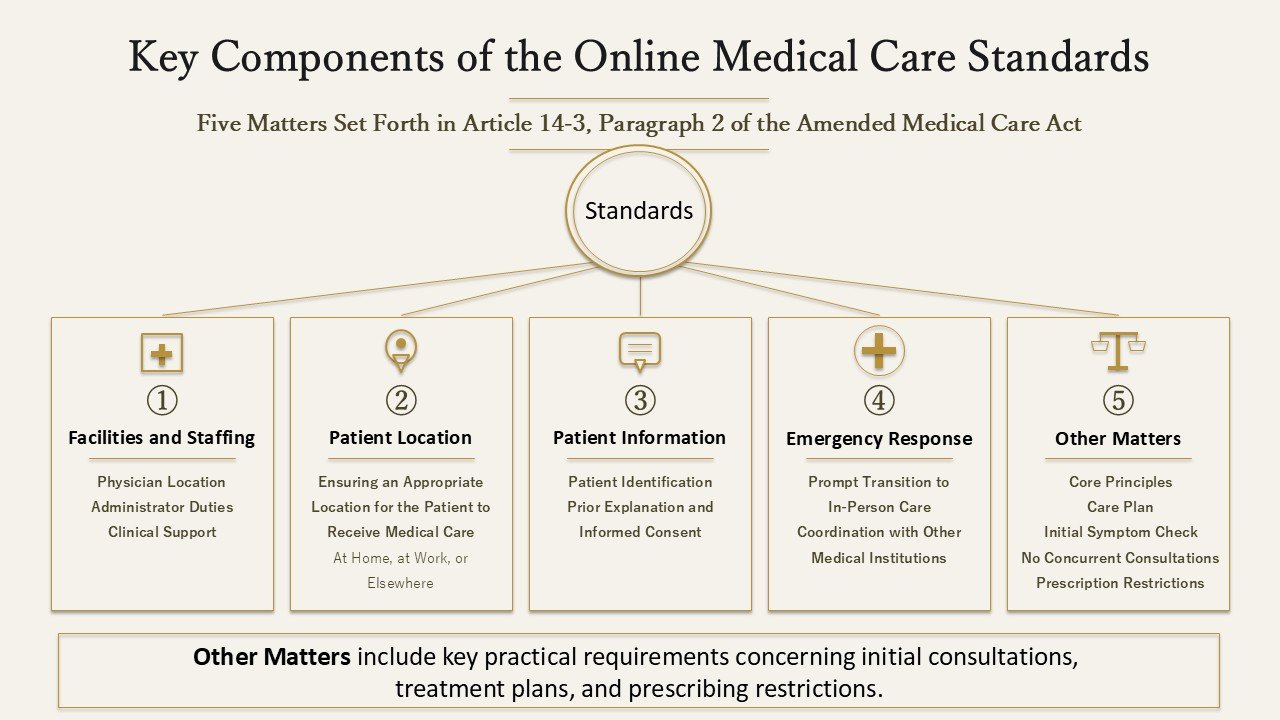
Key Requirements of the Telemedicine Standards
The principal requirements prescribed by the Telemedicine Standards are summarized below.
◆ Requirements Relating to Facilities, Equipment and Personnel (Article 14-3(2)(i) of the Medical Care Act)
With respect to the requirements relating to facilities, equipment and personnel under the Regulation on Standards for Online Medical Consultations, the Regulation sets out rules concerning, among other matters, the location of physicians and other healthcare professionals, the responsibilities of medical institution administrators, and the scope of assistance that may be provided in connection with medical treatment, as outlined below.
|
Category
|
Key Requirements |
|
Location of Physicians
(Article 9-6-14 of the Ordinance for Enforcement)
|
- Physicians and dentists must be affiliated with a hospital or clinic and disclose the name and contact details of the relevant medical institution. For this purpose, "affiliation" means an employment relationship and includes part-time practitioners as well as physicians and dentists serving as the founder or administrator of the medical institution.
- Online medical consultations must not be conducted from any location that could impair the physician's ability to exercise appropriate professional judgment.
- Except where emergency circumstances make this impracticable, physicians and dentists must have access to medical records and other relevant information to ensure that they can adequately ascertain the patient's condition.
- Online medical consultations must be conducted in a private space to prevent the unauthorized disclosure of patient information.
|
|
Administrator's Obligations
(Article 9-6-15 of the Ordinance for Enforcement)
|
- The administrator of a hospital or clinic must publicly disclose, on the institution's website or through notices displayed within the facility, that the online medical services provided by the institution comply with the Telemedicine Standards.
- The administrator of a hospital or clinic must implement appropriate measures with respect to the electronic information processing system used for online medical consultations, including measures to ensure information security and provide appropriate explanations to patients.
|
|
Clinical Assistance by Allied Healthcare Professionals
(Article 9-6-12 of the Ordinance for Enforcement)
|
- Within the scope reasonably anticipated under a treatment plan or home-visit nursing instructions, a physician may permit nurses and other allied healthcare professionals employed by the same medical institution, including physical therapists (PTs), occupational therapists (OTs), and speech-language-hearing therapists (STs), to provide clinical assistance.
- Within the scope reasonably anticipated under a treatment plan, a dentist may permit dental hygienists employed by the same medical institution to provide assistance in dental treatment.
|
◆ Requirements Relating to the Location from Which Patients Receive Online Medical Consultations (Article 14-3, Paragraph 2, Item 2 of the Medical Care Act)
The Ordinance for Enforcement sets out the following requirements regarding the environment in which patients receive online medical consultations, including requirements relating to the location where patients receive consultations and the obligations of operators of online medical consultation facilities.
|
Category
|
Key Requirements
|
|
Patient Location Requirements
(Article 9-6-16 of the Ordinance for Enforcement of the Medical Care Act)
|
- The location where a patient receives an online medical consultation must be clean and safe.
- A patient must receive an online medical consultation in a physically isolated space to protect the patient's personal information.
|
|
Requirements for Online Medical Consultation Facilities
(Articles 9-6-17 and 9-6-18 of the Ordinance for Enforcement of the Medical Care Act)
|
- Appropriate measures must be implemented to ensure that the location is clean and safe and consists of a physically isolated space that protects the patient's personal information.
- Appropriate measures must be implemented to ensure information security.
- A person responsible for the management and operation of the facility must be designated.
|
◆ Requirements Relating to Explanations Provided to Patients (Article 14-3, Paragraph 2, Item 3 of the Medical Care Act)
The requirements for patient identification, prior explanations, and obtaining consent are as follows.
|
Category
|
Key Requirements
|
|
Patient Identity Verification
(Article 9-6-5 of the Ordinance for Enforcement of the Medical Care Act)
|
- Physicians and patients must verify each other's identities using documents or other appropriate means, except where there are unavoidable circumstances or other exceptional cases.
- Physicians must disclose their names using identification documents bearing photographs or other equivalent documentation.
- Physicians must establish an environment in which patients can verify that the physician holds the relevant qualification as a physician or dentist.
|
|
Prior Explanation and Consent
(Article 9-6-6 of the Ordinance for Enforcement of the Medical Care Act)
|
- Before commencing an online medical consultation, physicians must provide the following four explanations to patients (or, in emergency situations, provide such explanations promptly thereafter):
①The fact that information available through online medical consultations is more limited than that available through in-person consultations and that online medical consultations should, in principle, be combined with in-person consultations.
②The benefits of online medical consultations and any potential disadvantages that may arise.
③The fact that the physician will determine, for each consultation, whether an online medical consultation is appropriate.
④Matters included in the treatment plan. - An online medical consultation may only be conducted after expressly confirming that the patient wishes to receive the consultation online and obtaining the patient's consent.
- If another physician or healthcare professional is present during an online medical consultation, the patient must be informed of such presence and provide consent each time.
- If video, audio, or other data from an online medical consultation is to be recorded or stored, the relevant arrangements must be clarified in advance and agreed upon with the patient.
|
◆ Requirements Relating to Establishing a System for Responding to Sudden Changes in a Patient's Condition (Article 14-3, Paragraph 2, Item 4 of the Medical Care Act)
To ensure a smooth transition to in-person medical consultations in the event of a sudden change in a patient's condition, the requirements regarding the determination of whether online medical consultations should be conducted, the discontinuation of such consultations, and the establishment of coordination systems are set out as follows.
|
Category
|
Key Requirements
|
|
Determination of Whether to Conduct and Discontinuation of Online Medical Consultations
(Article 9-6-7 of the Ordinance for Enforcement of the Medical Care Act)
|
- Physicians must determine, from a medical perspective, whether an online medical consultation is appropriate on a case-by-case basis.
- If a physician determines that an online medical consultation is inappropriate, including in cases of sudden illness or a sudden change in the patient's condition, the physician must promptly discontinue the online consultation and either transition the patient to an in-person consultation or refer the patient to an appropriate physician or medical institution.
- Where an emergency response is required, the physician must promptly encourage the patient to seek an in-person medical consultation.
|
|
Establishment of a Coordination System
(Article 9-6-8 of the Ordinance for Enforcement of the Medical Care Act)
|
- Where online consultations are provided by a physician other than the patient's primary care physician, an appropriate framework must be established to enable a transition to in-person consultations where necessary.
- An appropriate framework must be established to ensure that, in the event of an acute illness or sudden deterioration in the patient's condition, the patient can promptly receive an in-person consultation at a hospital or clinic.
|
◆ Other Requirements for the Appropriate Provision of Telemedicine
The following requirements are prescribed with respect to the basic principles governing online medical care and the matters that must be included in the medical care plans required to be prepared and retained.
|
Category
|
Key Requirements
|
|
Basic Principles
(Article 9-6-3 of the Enforcement Regulation)
|
- Purpose: To improve the quality of medical care, ensure patients have access to necessary medical services, and maximize treatment outcomes by promoting patients' active participation in their treatment.
- Limitations of online medical care: As online medical care provides more limited information than in-person consultations, it should, in principle, be provided in combination with in-person consultations.
- Patient-centered provision: Online medical care should be provided at the patient's request and must not be provided solely for research purposes or for the convenience of the physician.
|
|
Medical Care Plan
(Article 9-6-4 of the Enforcement Regulation)
|
- As a general rule, the patient should first undergo an in-person consultation. A medical care plan must then be established and retained for two years, setting out the following:
①Specific details of the medical care to be provided
②The use of online medical care in combination with in-person consultations and examinations
③Consultation hours
④The method of providing online medical care
⑤⑤Conditions for discontinuing online medical care and the policy for transitioning to in-person care
⑥The need for the patient's active cooperation
⑦The policy for responding to sudden illness or an acute change in the patient's condition
⑧The names and other relevant information of physicians involved where multiple physicians participate in the patient's care
⑨The allocation of responsibility for cybersecurity - Where online medical care is provided from the initial consultation, the patient must be informed, following the consultation, of the date and method of the next consultation, the medical institution to visit in the event of a sudden change in condition, and other relevant matters. Where continued online medical care is expected, a medical care plan must be prepared and retained as soon as reasonably practicable.
|
|
Confirmation of the Patient's Condition at the Initial Consultation
(Article 9-6-9 of the Enforcement Regulation)
|
- Where a physician other than the patient's primary care physician provides online medical care from the initial consultation, the physician must confirm the patient's symptoms and relevant medical information using the same method as the online consultation itself (i.e., through a pre-consultation assessment), unless the physician has already obtained information such as the patient's medical history. Online medical care may be provided only where, following this assessment, the physician determines that it is appropriate to proceed and obtains the patient's consent. The information confirmed during the assessment must be recorded in the patient's medical record.
- Information regarding the possibility that online medical care may not be provided following the pre-consultation assessment, as well as any fees or other costs associated with the assessment, must be communicated in advance through the website or other appropriate means.
|
|
Exceptions to the Medical Care Plan Requirements
(Article 9-6-10 of the Enforcement Regulation)
|
- Where a collaborative system for home medical care is in place, or where multiple physicians from different medical specialties are involved in the patient's care, and the medical care plan specifies the involvement of multiple physicians with at least one of them providing in-person care, certain requirements concerning the preparation of the medical care plan and the confirmation required at the initial consultation do not apply to the other physicians.
- The same requirements also apply where a substitute physician provides online medical care after receiving sufficient handover information and obtaining the patient's consent, as well as where online medical care is provided primarily to individuals who are generally healthy.
|
|
Prohibition of Simultaneous Consultations with Multiple Patients
(Article 9-6-11 of the Enforcement Regulation)
|
- Physicians and dentists must not provide online medical care to multiple patients simultaneously.
|
|
Prescriptions
(Article 9-6-13 of the Enforcement Regulation)
|
- Physicians must verify the medications currently being taken by the patient each time they provide a prescription.
- In the case of an initial consultation, as well as in cases where no in-person consultation has taken place even though the consultation is not an initial consultation, the following prescriptions are prohibited:
① Narcotics and psychotropic drugs
② Medications requiring particularly careful safety management for patients whose underlying medical conditions and other relevant information have not been ascertained
③ Medications prescribed for eight days or more to patients whose underlying medical conditions and other relevant information have not been ascertained
|
Relationship with the Guidelines for the Appropriate Implementation of Online Medical Consultations
The Telemedicine Standards are set out in a ministerial ordinance and are legally binding. In the event of non-compliance, administrative measures may be taken by the relevant prefectural governor or other competent authority, including an order to take corrective action (Article 24-2, paragraph (1) of the Medical Care Act) and an order to suspend operations (Article 24-2, paragraph (2) of the Medical Care Act). In addition, where an operator fails to comply with an order to suspend operations, further administrative measures may be imposed, including revocation of the establishment approval or an order to close the facility (Article 29, paragraph (1) of the Medical Care Act).
At the same time, the Guidelines for the Appropriate Implementation of Online Medical Consultations (issued by the Director-General's notice) will remain in effect and will continue to serve a complementary role in relation to the Telemedicine Standards.
In the next article, we will explain the concept of "online medical consultation facilities."
[Related Links]
■ Amendments to the Medical Care Act
・Act Partially Amending the Medical Care Act and Other Related Acts
https://www.mhlw.go.jp/content/001681278.pdf
・Cabinet Order Partially Amending the Enforcement Order of the Medical Care Act and Other Related Cabinet Orders
https://www.mhlw.go.jp/content/001681281.pdf
・Ministerial Ordinance Partially Amending the Regulation for Enforcement of the Medical Care Act and Other Related Ministerial Ordinances
https://www.mhlw.go.jp/content/001681282.pdf
・"Q&A on Online Medical Consultations" (prepared in March 2026)
https://www.mhlw.go.jp/content/001681026.pdf
■ Implementation Notice
・"Implementation of Certain Provisions of the Act Partially Amending the Medical Care Act and Other Related Acts (Regarding Online Medical Consultations)" (Health Policy Bureau Director-General Notice No. 0327-5 dated March 27, 2026, issued by the Health Policy Bureau of the Ministry of Health, Labour and Welfare)
https://www.mhlw.go.jp/content/001681277.pdf
■ Guidelines for the Appropriate Implementation of Online Medical Consultations / Q&A (Revised April 2026 Edition)
・"Guidelines for the Appropriate Implementation of Online Medical Consultations" (Revised April 2026)
https://www.mhlw.go.jp/content/001685701.pdf
• Q&A Regarding the "Guidelines for the Appropriate Implementation of Online Medical Consultations"
https://www.mhlw.go.jp/content/001686805.pdf
■ Reference: Ministry of Health, Labour and Welfare, "Online Medical Consultations"
https://www.mhlw.go.jp/stf/index_0024_00004.html