
ブログ
[Series] Japan Patent Prosecution 101 - Part 3: What to Send Japanese Counsel: Paris vs. PCT
2026.10.15
SHARE


In Part 1, we explored the two main routes for obtaining patent protection in Japan: —Paris direct filing and PCT national phase entry—and in Part 2, we examined the deadlines for each route. In Part 3, we turn to a more practical question: what documents and information Japanese counsel will actually need from you.
While both the Paris and PCT routes ultimately lead to the Japan Patent Office (JPO), the filing requirements are not the same. A Paris Convention filing claims priority to an earlier application but is filed as a new Japanese application. By contrast, a PCT national phase entry is based on an existing international application.
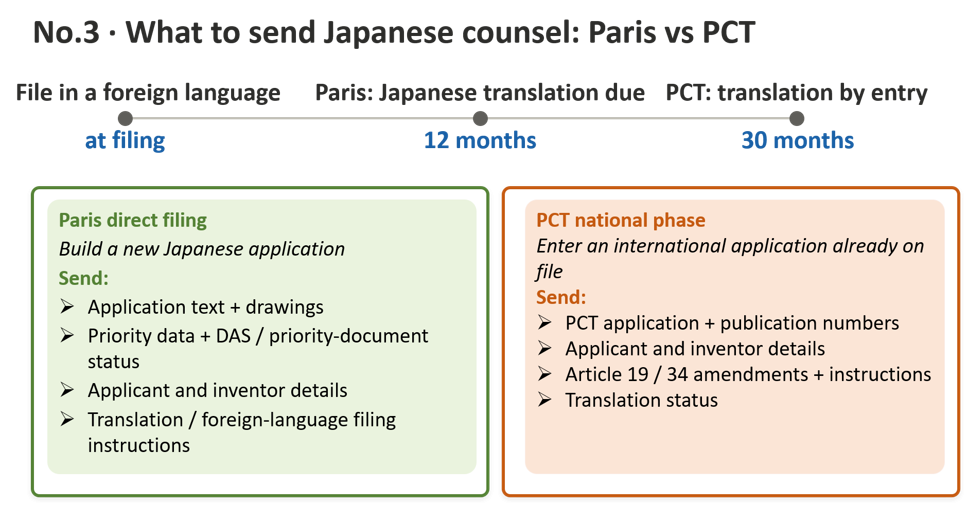
That distinction affects the materials that Japanese counsel will require. For a Paris filing, think in terms of the complete application documents together with the necessary priority information. For a PCT national phase entry, the focus is on entry details, the Japanese translation discussed in Part 2, and instructions regarding any amendments made under PCT Article 19 or 34.
Why this matters
For a Paris filing, the 12-month priority deadline usually drives the project. Japanese counsel needs the application text, applicant and inventor information, and the priority data needed to prepare the new Japanese filing. Where DAS is available and the necessary arrangements have been made for the JPO to retrieve the priority document, no separate submission of the priority document is required. Otherwise, the priority document must generally be submitted within 16 months of the earliest priority date. Whether the priority document is retrieved through DAS or submitted as a certified copy, a Japanese translation of it is generally not required at filing.
For PCT national phase entry, the international application is already the legal foundation of the Japanese case. If a priority document was properly furnished or retrieved in the international phase, it normally does not need to be filed again simply because the case enters Japan. The focus shifts to the national document for entry into the Japanese national phase, translation, and correct handling of any Article 19 or 34 amendments. If there are any unresolved issues with the priority document from the international phase, let Japanese counsel know early.
What to prepare for Japanese counsel
For Paris direct filing
- Final specification, claims, abstract and drawings
- Priority country/office, application number and filing date
- DAS access information or priority-document status, if available
- Applicant and inventor names and addresses
- Japanese translation, or instructions regarding the translation, including which party will prepare it and, if it will be prepared by the applicant(s), when it is expected to be provided
For PCT national phase entry
- PCT application number and international publication number
- Any Japanese-language names for the applicant(s) and inventor(s), if available, for use in the national document and related documents
- Any amendments made under PCT Article 19 or Article 34, together with instructions on whether those amendments should be reflected in the Japanese application
- Japanese translation status and any terminology instructions
- Priority-document status only if there is doubt that the international record shows it was not furnished
Takeaway
For Paris filings, Japanese counsel prepares and files a separate Japanese patent application claiming the relevant priority. For PCT, the application record already exists internationally. The practical filing package should reflect that difference rather than treating the two routes as interchangeable.
Official basis checked: Patent Act and JPO guidance on Paris priority, DAS and PCT national-phase procedures, including the treatment of priority documents under PCT Rule 17.1 (current as of September 2026).
This article is for general informational purposes only and does not constitute legal advice. Rules and practice may change, and outcomes depend on individual circumstances. For specific matters, please consult qualified patent counsel.
Member
PROFILE

SHARE