
ブログ
[Series] Japan Patent Prosecution 101 - Part 4: Applicant vs. Inventor: Who Owns the Right to File?
2026.10.19
SHARE


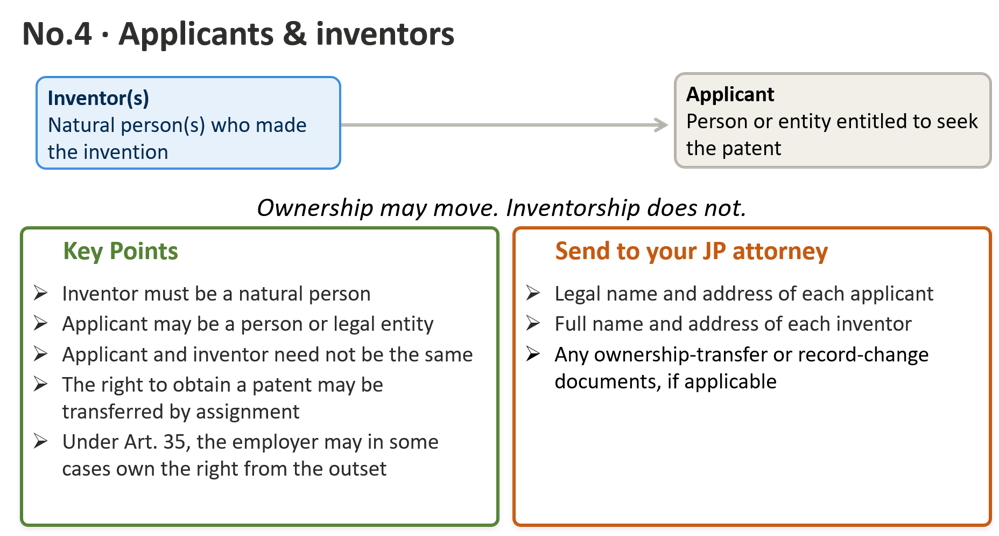
Japan draws a clear distinction between the inventor and the applicant. The inventor is the natural person who made the invention. The applicant is the person or entity entitled to seek a patent. In commercial cases, the applicant is often the employer or another company—but the two roles are not interchangeable.
The path of ownership also matters. The right to obtain a patent can be transferred by assignment, while Japan's employee-invention rules can, in certain cases, cause the right to vest in the employer from the outset if an advance agreement, work rule, or similar arrangement is in place.
Why this matters
A spelling inconsistency may be a formality issue; an entitlement issue is more serious. An application filed by someone who is not entitled to obtain the patent may be refused, and a patent granted on that basis may be invalidated. Japanese counsel should therefore be able to answer two separate questions: who actually made the invention, and why does the named applicant own the right to obtain a patent? The JPO assigns an Applicant Identification Number (AID) to each applicant and maintains the applicant's name and address information under that number. An AID is an administrative identifier only and does not determine inventorship or ownership.
Practical points
List every actual inventor and only actual inventors. A corporation, AI system, or other non-natural person cannot be named as an inventor. For the applicant, use the correct legal name and address and keep them consistent across related Japanese cases.
For employee inventions, do not automatically assume that the inventor first owns the right and later assigns it to the company. Under Patent Act Art. 35(3), an appropriate advance arrangement can make the employer the original holder of the right. Joint ownership also deserves an early commercial review because transfer of a share and third-party licensing generally require the consent of the other co-owners.
Japanese patent applications generally do not require inventor-to-applicant assignment documents or inventor signatures at filing. However, the applicant must have a valid basis for entitlement, and changes in ownership after filing may require separate procedures and supporting documents.
Once an AID is assigned, the same AID should generally be used for all subsequent filings by that applicant. If an application is filed without referencing an existing AID and the Japanese-language name or address differs even slightly from the information already recorded, a new AID may be issued. Changes to an applicant’s name or address are recorded against the existing AID and are reflected across all pending JPO cases associated with that AID. For this reason, if the applicant has filed in Japan before, providing the existing number helps Japanese counsel maintain consistent applicant records and avoid duplicate identification numbers.
What to prepare for Japanese counsel
- Legal name and address of each applicant
- Existing AID, if known
- Full name and address or residence of each inventor
- The basis of ownership: assignment, employee-invention rules, merger/succession, or another valid mechanism
- Any assignment, merger, name-change, or joint-ownership documents that affect the Japanese record
Takeaway
Inventorship asks who made the invention. Applicant status asks who owns the right to seek a patent. Check the ownership mechanism before filing, particularly for employee inventions and jointly owned rights, and use the applicant's existing JPO identification number to keep Japanese records consistent.
Official basis checked: Patent Act Arts. 33, 35, 36 and 38; JPO guidance on inventors, employee inventions and JPO identification numbers (current as of September 2026).
This article is for general informational purposes only and does not constitute legal advice. Rules and practice may change, and outcomes depend on individual circumstances. For specific matters, please consult qualified patent counsel.
Member
PROFILE

SHARE