
ブログ
[Series] Japan Patent Prosecution 101 - Part 5: Patent Power of Attorney in Japan: When Is It Required?
2026.10.22
SHARE


One of the most common questions from foreign applicants is whether a power of attorney (POA) must be submitted when filing a patent application in Japan. In most cases, the answer is no. Japanese patent counsel can file and prosecute a patent application without a POA. This includes routine prosecution activities such as filing examination requests and responding to Office Actions.
That said, there are limited exceptions where a POA may be required, such as withdrawing an application or appointing a new representative after filing. Understanding these exceptions—and the benefits of a general POA—can help foreign applicants avoid unnecessary paperwork and delays.
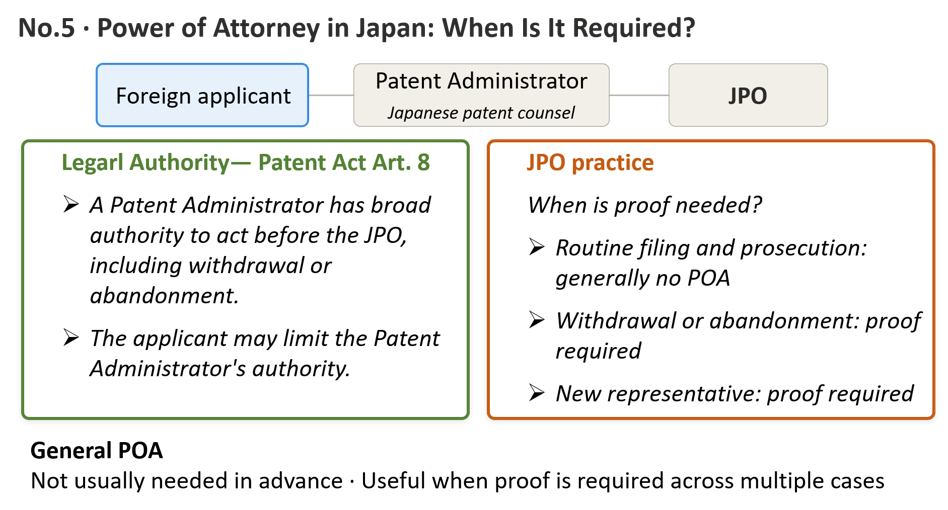
Why this matters
Under the Patent Act, Japanese counsel acting as a Patent Administrator for a foreign applicant generally has broad authority to act before the JPO, including to withdraw or abandon an application, unless that authority has been restricted by the applicant.
In practice, however, the JPO may require proof of authority for certain acts that could adversely affect the applicant, such as the withdrawal or abandonment of an application. Under the Regulations under the Patent Act, the JPO may seek confirmation that the Patent Administrator's authority has not been limited. This requirement is intended to protect applicants from unauthorized actions.
Practical points
When is a POA required?
For routine prosecution by the appointed Japanese counsel, no separate POA is ordinarily required. However, under the JPO's requirements for proof of authority, certain procedures, such as the withdrawal or abandonment of an application or the appointment of a new representative after filing, may require documentary proof of authority. Supporting authorization documents may also be required for other procedures, such as changes in applicant ownership or actions taken by a representative who has not been formally appointed.
When is a general POA useful?
Because a POA is generally unnecessary for ordinary patent filing and prosecution, foreign applicants do not usually need to prepare a general POA in advance. However, a general POA can be useful when handling multiple procedures that require proof of authority, such as changing representatives across several applications or transferring a large portfolio of Japanese patents.
Once filed with the JPO, a general POA can be cited in multiple cases, provided that the relevant procedures fall within its scope. This reduces the need to prepare separate POAs for individual cases. A general POA does not, however, replace assignment documents or other documents required to establish ownership transfers.
Signature and notarization
For domestic JPO procedures, a foreign applicant generally does not need to sign or seal a POA. Copies are accepted, and notarization or an apostille is generally unnecessary. Even when a POA is required, the associated formalities are relatively straightforward.
Does the Filing Route Matter?
For both Paris direct filings and PCT national phase entries, a POA is generally unnecessary when Japanese counsel handles the initial filing or entry procedure. PCT applications are subject to separate rules on when a non-resident must appoint a Patent Administrator.
What to prepare for Japanese counsel
- Select reliable Japanese patent counsel to act as your Patent Administrator.
- Specify any limitations on the Patent Administrator's authority, if necessary.
- Optionally, provide any existing general POA and its JPO reference number, if known.
Takeaway
For most Japanese patent filings and routine prosecution procedures, no POA is required. Although a Patent Administrator has broad statutory authority, the JPO requires proof of authority for certain procedures as a safeguard against unauthorized actions. A general POA is not usually needed for routine prosecution but can simplify procedures when multiple cases require such proof.
Patent Act Arts. 8 and 9; Rule 4-3 of the Regulations under the Patent Act; JPO guidance on Patent Administrators, proof of authority, general powers of attorney and signature requirements for domestic procedures (current as of October 2026).
This article is for general informational purposes only and does not constitute legal advice. Rules and practice may change, and outcomes depend on individual circumstances. For specific matters, please consult qualified patent counsel.
Member
PROFILE

SHARE