
ブログ
[Series] Japan IP Dispute Resolution 101 - Part 3: Protecting Confidential Information Submitted in IP Litigation in Japan
2026.11.04
SHARE


The “Japan IP Dispute Resolution 101” series provides a practical guide to handling IP disputes in Japan. In the previous installments, I introduced the fundamental framework and key practical features of IP litigation in Japan. In this installment and the next, I will discuss the mechanisms available under Japanese law to protect confidential information—such as trade secrets and proprietary technical data—during the course of IP litigation. In this Part 3, I will focus on how a party can protect confidential information contained in the briefs and evidence it submits to the court, covering restrictions on access to litigation records, protective orders, and confidentiality agreements (NDAs) between the parties.
Restriction on Access to Litigation Records (Code of Civil Procedure, Article 92)
Under the Code of Civil Procedure (CCP), litigation records including complaints, briefs, evidence, and judgments are generally open to public inspection (CCP, Article 91(1)). This is a fundamental aspect of the principle of “open justice” in Japan. Accordingly, as an initial step, a party may consider redacting portions of its evidence that are not relevant to the matters to be proved in the litigation, before submitting the evidence.
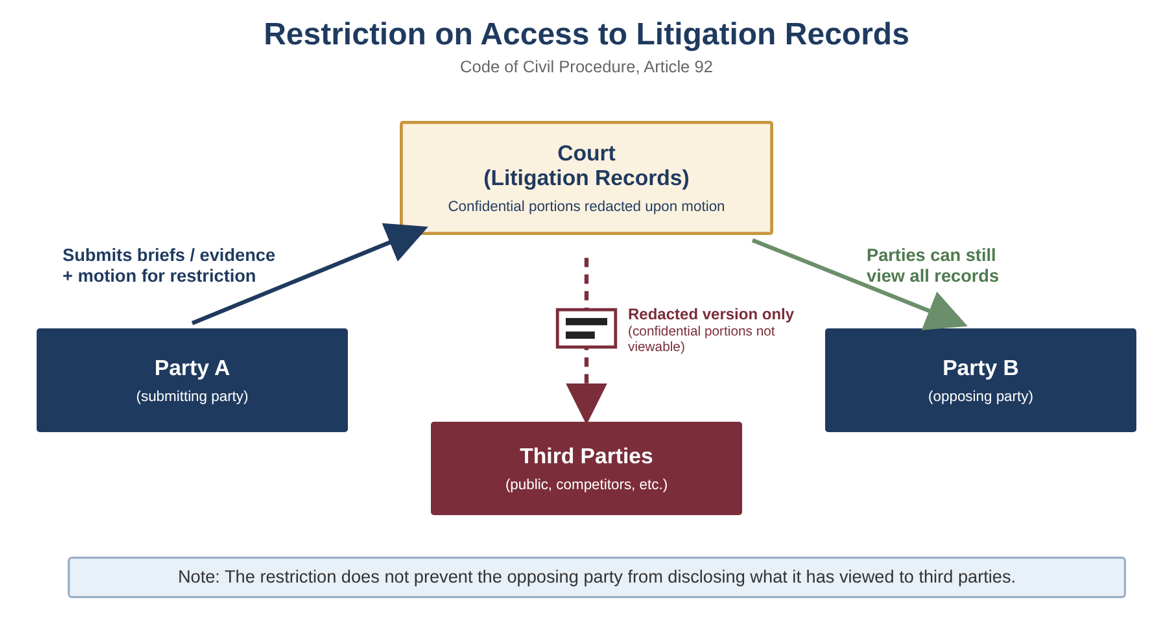
Even where such redaction is not an option, if the litigation records contain a party’s trade secrets, or material secrets relating to a party’s private life (limited to cases where third-party access would likely cause significant harm to that party’s social life), the court may, upon a motion by that party, issue a ruling restricting third-party access to the relevant portions of the record, in effect, redacting those portions from the publicly accessible record (CCP, Article 92(1)).
 Requirements for Qualifying as a Trade Secret:
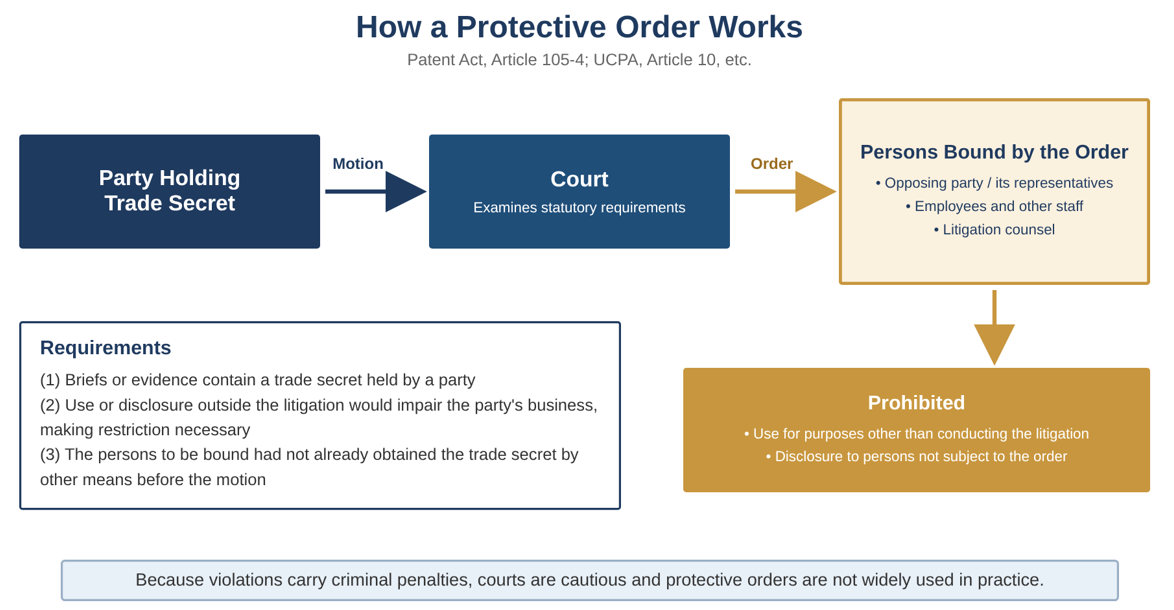
When seeking an access restriction on the grounds of trade secrets, the party must make a prima facie showing that the relevant portions constitute “trade secrets” as defined in Article 2(6) of the Unfair Competition Prevention Act (UCPA). Information qualifies as a trade secret if it satisfies the following three requirements:
(1) Secrecy management: the information is managed as confidential within the company (e.g., in addition to being labeled “Confidential,” access to the information is strictly limited);
(2) Usefulness: the information is technical or business information that is useful for business activities; and
(3) Non-public nature: the information is not publicly known.
Important Notes on Access Restrictions:
It is important to note that this restriction only limits access by third parties (i.e., persons who are not parties to the litigation). In other words, the parties themselves can still view the confidential portions of the record, and there remains a risk that the opposing party may disclose these contents to third parties outside the proceedings. As a result, restricting access to litigation records alone may not be sufficient to fully protect confidential information, and in practice it may be combined with the other measures discussed below.
Protective Orders
One way to require the opposing party to keep trade secrets confidential is to file a motion for a protective order. In infringement actions involving patents, utility models, designs, trademarks, and copyrights, as well as in unfair competition cases, where the briefs or evidence submitted by a party in the litigation contain trade secrets, that party may file such a motion (Patent Act, Article 105-4; Utility Model Act, Article 30; Design Act, Article 41; Trademark Act, Article 39; Copyright Act, Article 114-6; UCPA, Article 10). If the court finds that the statutory requirements are met, it may issue the order against the opposing party and certain related persons (such as its representatives, employees, and other staff) and/or its litigation counsel. The persons subject to the order are then prohibited from using the trade secrets for any purpose other than conducting the litigation, and from disclosing them to anyone who is not subject to the order.
Important Notes on Protective Orders:
While a restriction on access to litigation records limits third-party access to the records, a protective order prohibits specific persons, such as the opposing party, from using or disclosing the disclosed trade secrets outside the litigation.
However, because a violation of a protective order is subject to criminal penalties, courts take a cautious approach to issuing such orders, and protective orders are not widely used in practice. For this reason, a confidentiality agreement (NDA) between the parties, discussed below, is often used as a practical means of disclosing confidential information to the opposing party during litigation, while minimizing the risk.
Confidentiality Agreements (NDAs) Between the Parties
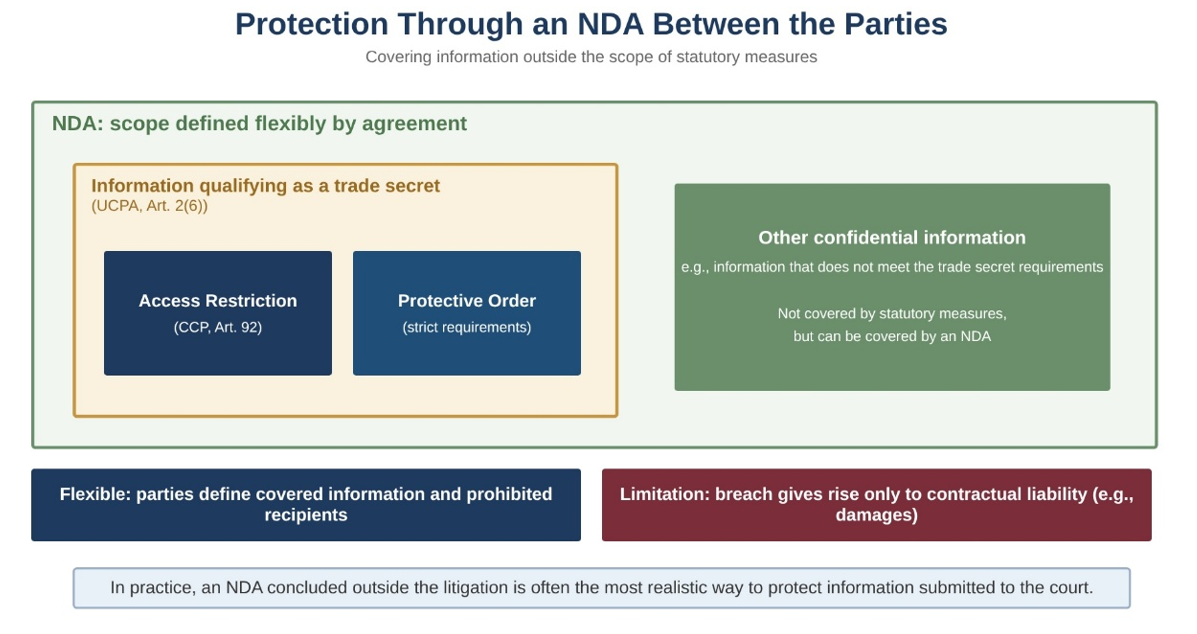
In practice, when submitting briefs or evidence containing confidential information, the parties often enter into a confidentiality agreement (NDA) outside the litigation and designate the confidential information contained in those submissions as subject to the NDA, thereby restricting the opposing party’s use or disclosure of that information outside the litigation.
In such cases, the parties can flexibly agree on the scope of the information subject to confidentiality obligations and the third parties to whom disclosure is prohibited, and the NDA can also cover information that does not meet the requirements of a trade secret.
 Important Notes on NDAs:
A breach of an NDA gives rise only to contractual liability (e.g., damages), and proving and quantifying the resulting damages can be difficult in practice. Nevertheless, given their flexibility, NDAs remain a practical option for protecting confidential information in IP litigation.
Takeaways
To protect confidential information that a party submits to the court, the party may first consider redacting portions that are not relevant to the matters to be proved, and the key step is to then file a motion to restrict third-party access to the litigation records. Beyond that, to prevent the opposing party from using or disclosing the information outside the litigation, a statutory protective order is available, but in practice, the more flexible NDA is often the most realistic option.
In Part 4, I will discuss how to protect confidential information when the opposing party requests the production of documents or testimony.
Member
PROFILE

SHARE