
ブログ
[Series] Japan Patent Prosecution 101 - Part 6: Assignment Procedures in Japan: Before Filing, Pending, and After Grant
2026.11.06
SHARE


The requirements for transferring patent-related rights in Japan depend on two factors: when the transfer occurs and how the rights are transferred.
Japan law distinguishes between specific succession, such as an ordinary assignment, and general succession, such as a merger or inheritance. It also distinguishes between a requirement for a transfer to take effect and a requirement for asserting that transfer against third parties. Understanding these distinctions is essential when transferring Japanese patent applications or granted patents.
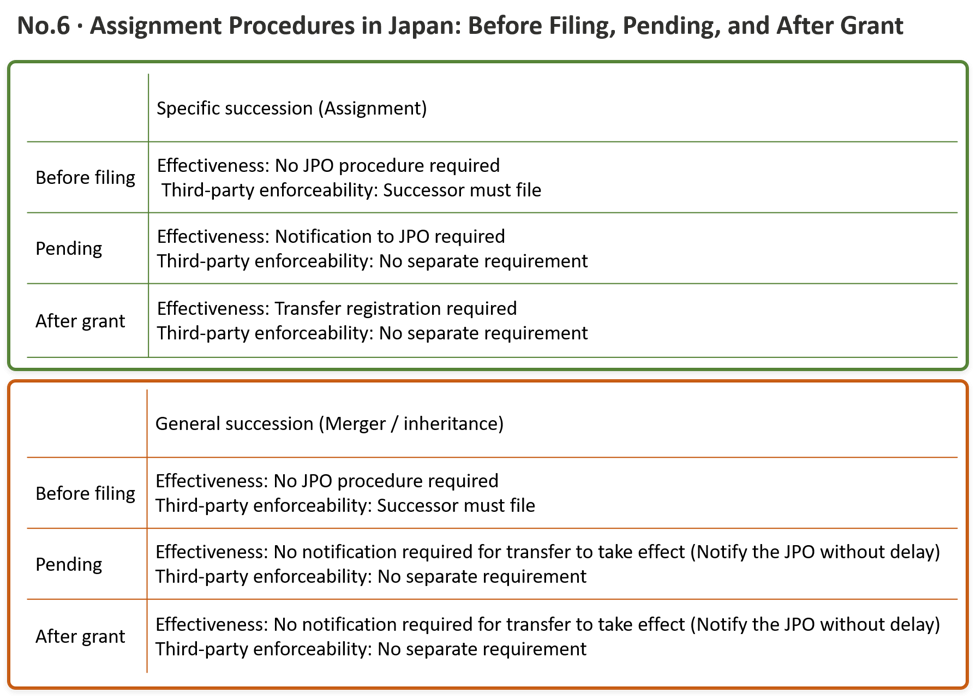 “No separate requirement” means that no additional third-party enforceability formality is specified under the transfer rules discussed here.
Why this matters
Before filing, succession to the right to obtain a patent can take effect without any procedure at the Japan Patent Office (JPO). However, under Patent Act Art. 34(1), the successor must file the patent application in order to assert that succession against third parties. Filing is therefore a requirement for third-party enforceability. It is not a requirement for the transfer itself to take effect.
The rules change after filing. For a specific succession while an application is pending, the transfer takes effect only when the JPO is notified (Art. 34(4)). After grant, an ordinary transfer of the patent right takes effect only when it is registered (Art. 98(1)). General succession is treated differently, as explained below.
Practical points
Specific succession: assignment
For an assignment before filing, the successor should file the Japanese application in its own name to satisfy the third-party enforceability requirement.
For an assignment while an application is pending, a Notification of Change of Applicant must be filed with the JPO. The JPO generally requires evidence of succession, such as an assignment document. The assignment date must not be later than the notification date.
After grant, the transfer must be registered in the patent register. A notification for a pending application can be filed by the assignee alone. In contrast, an application for transfer registration generally requires the cooperation of both the assignor and assignee, although there are exceptions to this joint-filing requirement.
General succession: merger or inheritance
General succession, such as a merger or inheritance, follows different rules. While an application is pending, the succession takes effect without notification to the JPO. However, the successor must notify the JPO without delay (Art. 34(5)).
Similarly, after grant, general succession takes effect without transfer registration. However, the successor must notify the JPO without delay (Art. 98(2)) and complete the procedure to update the patent register. Documents establishing the succession are required.
Practical documents and portfolio transfers
The documents required depend on the type of succession and the status of the case. For example, assignment or merger documents may be needed, together with Japanese translations of any relevant foreign-language documents. Additional documents may be required for jointly owned rights.
For transfers involving numerous Japanese applications or patents, we recommend contacting Japanese counsel early. Common supporting documents may be reused where permitted, and the JPO has procedures for handling transfers of multiple registered rights together.
What to prepare for Japanese counsel
- A list of Japanese applications and patents to be transferred, including their current status
- The type of succession (assignment, merger, inheritance, etc.) and its effective date
- The full legal names and addresses of the parties involved
- Assignment documents or other evidence of succession (Japanese counsel will confirm the required formalities and translations)
Takeaway
Before deciding which procedure is necessary, identify both the stage of the case and the type of succession.
Official basis checked: Patent Act Arts. 33, 34 and 98; JPO guidance on change of applicant and registration of assignment (current as of September 2026).
This article is for general informational purposes only and does not constitute legal advice. Rules and practice may change, and outcomes depend on individual circumstances. For specific matters, please consult qualified patent counsel.
Member
PROFILE

SHARE