
ブログ
Taberun Case (Reiwa 8 (2026) (Gyo-Ke) No. 10009)
2026.11.11
SHARE


Case Name
Taberun Case (Full Text of Judgment) (Summary) (Attached Document)
Plaintiff: Eatwell Corporation (Plaintiff’s Counsel: Hiroshi Mori)
Defendant: Tohto Consumers Co-operative (Defendant’s Counsel: Takashi Yoneya)
Case Number (Division/Presiding Judge)
- Judgment of the Intellectual Property High Court, June 29, Reiwa 8 (2026)
- Reiwa 8 (2026) (Gyo-Ke) No. 10009 (IP High Court, 2nd Division, Presiding Judge Yoshiaki Moritomi)
- Motion to Dismiss Decision Dismissing a Request for Cancellation of a Trademark Due to Non-Use
Content of the Judgment
This was a case in which the trademark registration was upheld on the grounds that, based on the evidence submitted by the Defendant, it was found to have been proven that the mark which is deemed identical to the Trademark at Issue according to generally accepted social norms), had been used during the relevant period in connection with the claimed services among the designated services.
Summary of the Case
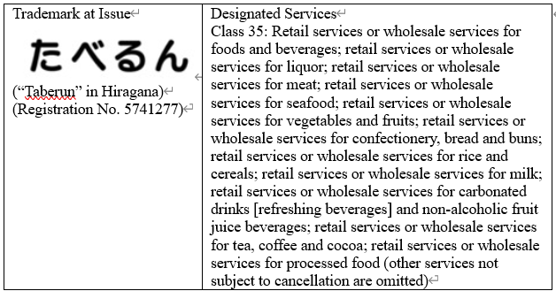
(1) The Plaintiff filed a petition for a trademark cancellation trial (the “Trial”) pursuant to Article 50, Paragraph 1 of the Trademark Act, seeking a decision to revoke the trademark registration for the Trademark at Issue with respect to the aforementioned designated services in Class 35. The registration of the petition for the Trial was made on December 17, 2024 (Cancellation Case No. 2024-300908).
(2) On December 18, 2025, the Japan Patent Office issued a decision stating that “the request for the present trial is without merit.”
[Key Points of the Ruling]
(1) Since the word “Taberun” (the “Mark in Use”) is displayed on the website provided by the Defendant (i.e., the trademark owner of the Trademark at Issue), as the name of one of the characters known as “Runrunz,” it can be said that the Mark in Use was used during the period in question.
On the website in question, the trademark owner is the one using the Mark in Use, and, based on the descriptions on the website, it can be inferred that the “My Special Choice” brand products include, at a minimum, food and beverage items.
Thus, it can be said that: on the website in question, advertising is conducted in a Q&A format regarding the retail services or wholesale services for food and beverages (the “Services in Use”) under the Defendant’s private brand, “My Special Choice”; and the Services in Use fall within the scope of the claimed services.
The Trademark at Issue and the Mark in Use can be considered identical under generally accepted standards. Furthermore, it is reasonable to view the characters referred to as “Runrun-zu” (including “Taberun”), as being displayed on the website in question for the purpose of promoting products of the “My Special Choice” brand. Thus, it can be said that the Mark in Use is being used on the website in question in connection with advertisements for the Services in Use.
(2) The Plaintiff argues that the Mark in Use is used solely as the name of the character in question and does not function as a mark identifying the source of the goods; however, it is reasonable to view the characters referred to as “Taberun-zu” (which include “Taberun”) on the website in question as being displayed to promote and advertise products in a Q&A format, and it can be said that the Mark in Use functions as a mark identifying the source of the goods.
Main Issue in Dispute
Does the term “use” as defined in Article 50, Paragraph 1 of the Trademark Act require only that a registered trademark be used in some manner with respect to the designated goods or services, or is it limited to use in a manner that serves to indicate origin (trademark use)?
Ruling on the Main Issue
Decision Upheld
Court’s Ruling
1. Article 50, Paragraph 1 of the Trademark Act provides that if, for a continuous period of three years or more, neither the trademark owner nor a licensee thereof has used the registered trademark in Japan with respect to any of the designated goods or designated services, any person may file a petition for a trial to cancel the trademark registration pertaining to those designated goods or designated services. The main text of Paragraph 2 of the same Article 50 provides that, if such a petition for a trial is filed, unless the respondent proves that, within the three years prior to the registration of the request for trial, the trademark owner or the licensee used the registered trademark in Japan in connection with any of the designated goods or designated services covered by the request, the trademark owner cannot avoid the cancellation of the trademark registration for those designated goods or designated services. This is understood as being based on the principle that granting exclusive rights to a registered trademark that is not in use would unduly infringe upon the public interest and narrow the range of choices available to prospective trademark users other than the rights holder, and would thereby be inappropriate in terms of ensuring the public interest.
Furthermore, in addition to the purpose of Article 50 of the Trademark Act, Article 26, Paragraph 1, Item 6 of the same Act specifies that, among the “trademarks” defined in Article 2 of the Trademark Act, the effect of the trademark right does not extend to “trademarks that are not used in a manner that allows consumers to recognize that the goods or services relate to the business of a particular person” (i.e., trademarks that are not used as a source identifier). In contrast, Article 50 of the Trademark Act does not impose any such limitation. Therefore, in order to satisfy the requirement of “using the registered trademark” as stated in the main text of Paragraph 2 of such Article 50, as the wording itself indicates, it is sufficient that the registered trademark be used in any manner with respect to the designated goods or services covered by the claim, and it is not necessary for the trademark to be used in a manner that allows consumers to recognize that the goods or services are associated with the business of a particular person.
2. Applying this reasoning to the present case, based on the evidence presented and the entirety of the arguments, the following facts are established regarding the use of the Mark in Use during the period in issue (from December 17, 2021, to December 16, 2024):
(1) The Defendant is a consumer cooperative established under the Consumer Cooperative Act, and it engages in activities such as purchasing goods necessary for its members’ daily lives and supplying such goods to its members, either after or without processing such goods, or by producing them. As of March 20, 2024, the Defendant had approximately 260,000 members.
(2) The website in question, which the Defendant made public on December 15, 2021, targeting general consumers in Japan (and which contains the same content as the Defendant’s website during the period in question), includes the following statements regarding the Defendant’s private brand (“My Special Choice”): “The concept of our new private brand ‘My Special Choice’ is to create products that meet your dietary preferences, developed through collaboration between producers and consumers to ensure a dining experience that is always safe, delicious, and enjoyable,” “The newly revamped / Toto Co-op private brand products / will make your meals delicious and bring you happiness!” “...To answer members’ questions, the ‘Runrun-zu’ have conducted a thorough investigation.…We’ll uncover the secrets behind the private brand ‘My Special Choice.’” In addition to these statements, the text “‘My Special Choice’ Investigation Team” and “We’ll Answer Everyone’s Questions!” appear in red text across two rows; in the upper right corner of the top row, there are illustrations of three characters, and directly below the same illustrations in the middle row, the black text “Kubarun,” “Taberun,” and “Tsukurun” appear in black text, corresponding to each character; in the lower row, the text “The Three-Character ‘Runrunz’” appears in black. Following this, in a Q&A format, alongside images of multiple food and beverage products that form part of the private label products, explanations are provided regarding the private label’s philosophy, policies, and approach, as well as the quality and features of the private label products, and the reasons for selecting the packaging design and logo.
(3) Both the Trademark at Issue and the Mark in Use consist of the characters “Taberun” written horizontally and are recognized as identical under generally accepted social standards.
Furthermore, based on the aforementioned findings of fact, it can be concluded that the Defendant, as the trademark owner of the Trademark at Issue, by publishing the website in question, engaged in “use” falling under Article 2, Paragraph 3, Item 8 of the Trademark Act within Japan during the relevant period, specifically with respect to one of the claimed services (“retail services or wholesale services for food and beverages”) by way of affixing the Mark in Use to advertisements for such services and providing them by electronic means. Consequently, pursuant to the main text of Article 50, Paragraph 2 of the Trademark Act, the registration of the Trademark at Issue for the claimed services cannot be revoked.
The Plaintiff argues that, on the website in question, the word “Taberun” is merely displayed in a manner associated with a character image or as the name of a character or as a member of a group of characters, and that this can therefore not be considered to constitute “use” as defined in Article 50 of the Trademark Act, and does not constitute use in connection with the claimed services. However, as stated above, “use” as defined in such Article 50 is not limited to trademark use. Rather, it is sufficient that the mark be used in any manner in connection with the designated goods or services at issue. Therefore, the Plaintiff’s argument cannot be accepted.
Comments
Regarding “use” in cancellation proceedings for non-use (Trademark Act, Article 50, Paragraph 1), whether such use must be in the context of a trademark has long been a matter of dispute, with case law and legal scholarship divided between those holding that trademark use is required and those holding that it is not. On this point, the present judgment holds that “use” is not limited to trademark use; rather, it is sufficient if the registered trademark is used in any manner whatsoever in connection with the designated goods or services subject to the request for cancellation.
However, as noted in this judgment, the purpose of cancellation proceedings for non-use is understood to be that granting exclusive rights to a registered trademark that is not in use narrows the range of choices available to prospective trademark users and is therefore not in the public interest. Since the essential function of a trademark lies in its ability to distinguish one’s own goods or services from those of others, it should be considered that, in order for the “use of a registered trademark” as referred to in Article 50 of the Trademark Act to be established, the registered trademark must be used in a manner in which it can be recognized as indicating the source of the goods or services and distinguishing them from those of others. Therefore, it must be said that holding that mere use in any form is sufficient to avoid cancellation would run counter to the purpose of non-use cancellation proceedings and place undue emphasis on the protection of the rights holder.
This judgment also cites the difference in the respective wordings of Articles 50 and 26 of the Trademark Act as the basis for its finding that the term “use” as defined in Article 50 is not limited to trademark use; however, Article 26, Paragraph 1, Item 6 of the Trademark Act is intended to prevent third parties from hesitating to use non-distinctive characters, etc., due to the existence of a registered trademark containing such non-distinctive characters, and therefore provides that the effect of trademark rights does not extend to “a trademark that is not used in a manner that enables consumers to recognize that the goods or services relate to the business of a particular person,” i.e., a trademark that does not fulfill the function of identifying the source, which is one of the essential functions of a trademark. In other words, since such a trademark does not fulfill the essential function of a trademark, the provision merely confirms that even if the act is formally considered to fall under “use” of a trademark, this alone does not constitute trademark infringement. Therefore, not only is this provision not directly related to whether the term “use” in Article 50 of the Trademark Act is limited to trademark use, but treating use in a manner that fails to fulfill the function of identifying the source as “trademark use” would, in fact, appear to contradict the provisions of Article 26. Since the essential function of a trademark is to identify the source of a good or service, it has to be said that recognizing the use of a mark that fails to fulfil this function as “trademark use” and maintaining its registration would run counter to the purpose of the Trademark Act. Rather, it would be more appropriate to strike a balance between the protection of trademark users (rights holders) and the rights of prospective trademark users by adopting a flexible approach to the recognition of “trademark use.”
Member
PROFILE

SHARE