
ブログ
[Series] Japan Patent Prosecution 101 - Part 7: Grace Period in Japan: What to Do After Public Disclosure
2026.11.16
SHARE


A conference presentation went online. A product was shown at an exhibition. A paper or press release appeared before a patent application was filed. In Japan, such disclosures do not necessarily rule out patent protection. Article 30 of the Patent Act provides a one-year grace period for certain public disclosures.
However, the grace period is a safety net, not a substitute for filing first. It can prevent qualifying disclosures from being cited against an invention when novelty and inventive step are assessed. It does not move the filing date back to the disclosure date. Nor does it eliminate the risks posed by independent third-party disclosures or filings.
Why this matters
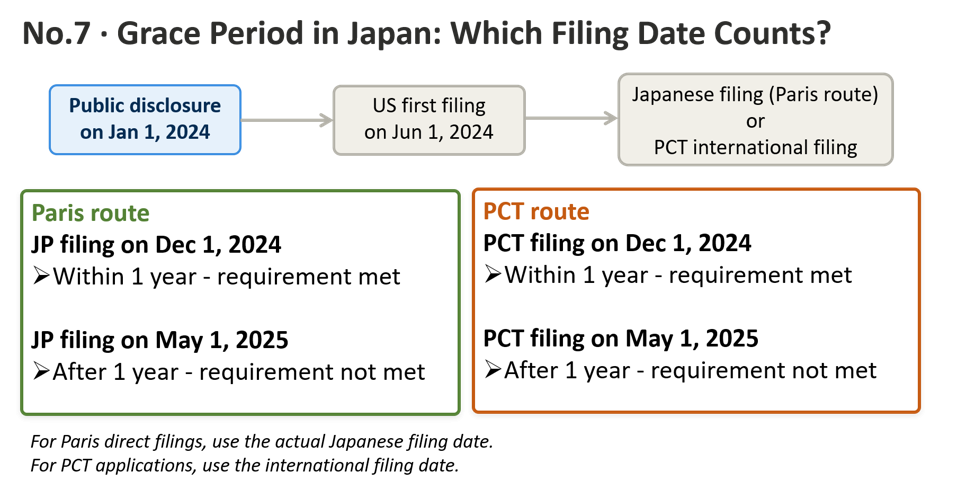
To benefit from Japan's grace period, the applicant must generally file a patent application within one year of the public disclosure. The one-year period is the same for Paris direct filings and PCT applications. However, the filing date used to determine compliance differs. For Paris direct filings, the actual Japanese filing date is used. For PCT applications, the international filing date is used. In neither case is the foreign priority date used for this purpose.
For example, suppose an invention was publicly disclosed on January 1, 2024, and a first patent application was filed in the United States on June 1, 2024. If a Japanese application claiming Paris Convention priority, or a PCT international application, is filed on December 1, 2024, the one-year requirement is satisfied in either case. If either application is instead filed on May 1, 2025, the requirement is not satisfied, even though both applications can still claim priority to the earlier US application.
A valid Paris Convention priority claim may allow novelty and inventive step to be assessed as of the foreign priority date. However, the priority date does not extend the one-year grace period under Article 30. For PCT applications, entering the Japanese national phase after the one-year period does not affect the calculation, provided that the international application was filed within that period.
Practical points
How to claim the grace period
For a Paris direct filing, the applicant must submit a statement of its intention to rely on Article 30 at the time of filing. The applicant must then submit a supporting document proving the disclosure within 30 days after the filing date.
For a PCT application, the procedure in Japan follows a different timetable. The Article 30 statement and supporting document must generally be submitted within 30 days after the “national processing standard time.” If a declaration under PCT Rule 4.17(v) was made during the international phase, the separate Article 30 statement may be omitted. However, the supporting document is still required.
Qualifying disclosures and supporting documents
Qualifying disclosures may include publications, website postings, conference presentations, product sales, exhibitions, and other public acts. However, publication in a patent, utility model, design, or trademark gazette, including gazettes issued by foreign patent offices, does not qualify. Apart from this exclusion, the form of the disclosure does not matter. What matters is whether the disclosure resulted from an act of the person entitled to obtain the patent and whether it satisfies the applicable requirements.
The supporting document should establish what was disclosed, when and where the disclosure occurred, who made it, and the relationship between that person and the person entitled to obtain the patent.
If an invention has been disclosed multiple times, each disclosure should generally be considered when claiming the exception. For example, a conference presentation may be followed by a journal publication and a website posting. Inform Japanese counsel of all such disclosures, even though separate supporting documents may not be necessary for certain related disclosures.
Article 30 may also apply where an invention was disclosed against the will of the person entitled to obtain the patent, for example, through a breach of confidentiality. Different requirements apply in such cases.
What about divisional applications?
For a divisional application, compliance with the one-year period is generally assessed based on the filing date of the original application, provided that the required Article 30 supporting document was submitted for the original application. In that case, the Article 30 statement and supporting document are generally deemed to have been submitted for the divisional application as well.
Although this situation may be rare, the applicant may still be able to rely on the grace period for the divisional application even if the Article 30 procedures were not completed for the original application. In that case, however, compliance with the one-year period is assessed based on the actual filing date of the divisional application, not the filing date of the original application. The divisional application itself must therefore be filed within one year of the public disclosure. The applicant must also submit the Article 30 statement when filing the divisional application and submit the supporting document within 30 days after that filing date.
What to prepare for Japanese counsel
- The dates, methods, and contents of all relevant public disclosures
- Evidence of what was actually disclosed, such as papers, presentation slides, webpages, brochures, videos, or product materials
- Details of who made each disclosure, their relationship to the inventor or the person entitled to obtain the patent, and any relevant chain of title
- For a PCT application, confirmation of whether a declaration under PCT Rule 4.17(v) was made during the international phase
Takeaway
Japan provides a one-year grace period for qualifying public disclosures. The period is the same for Paris direct filings and PCT applications, but the relevant filing date differs. It is the actual Japanese filing date for Paris filings and the international filing date for PCT applications. Neither route uses the foreign priority date to calculate the grace period.
The grace period does not create an earlier filing date. Nor does it eliminate the risks of independent third-party disclosures or filings. File as early as possible, preserve evidence of all relevant disclosures, and inform Japanese counsel promptly so that the required procedures can be completed on time.
Official sources checked:
Articles 30, 44, and 184-14 of the Patent Act; Japan Patent Office (JPO) Examination Guidelines, Operational Guidelines, and procedural guidance on exceptions to lack of novelty (current as of October 2026).
This article is for general informational purposes only and does not constitute legal advice. Rules and practice may change, and outcomes depend on individual circumstances. For specific matters, please consult qualified patent counsel.
Member
PROFILE

SHARE