
ブログ
[Series] Japan Patent Prosecution 101 - Part 8: Sequence Listings in Japan: When Are They Required?
2026.11.20
SHARE


Patent applications that contain nucleotide or amino-acid sequences may require a sequence listing. A sequence listing presents the sequences in a standardized format, together with related information such as sequence identification numbers, lengths, and types. This international standard helps patent offices search, examine, and exchange sequence information.
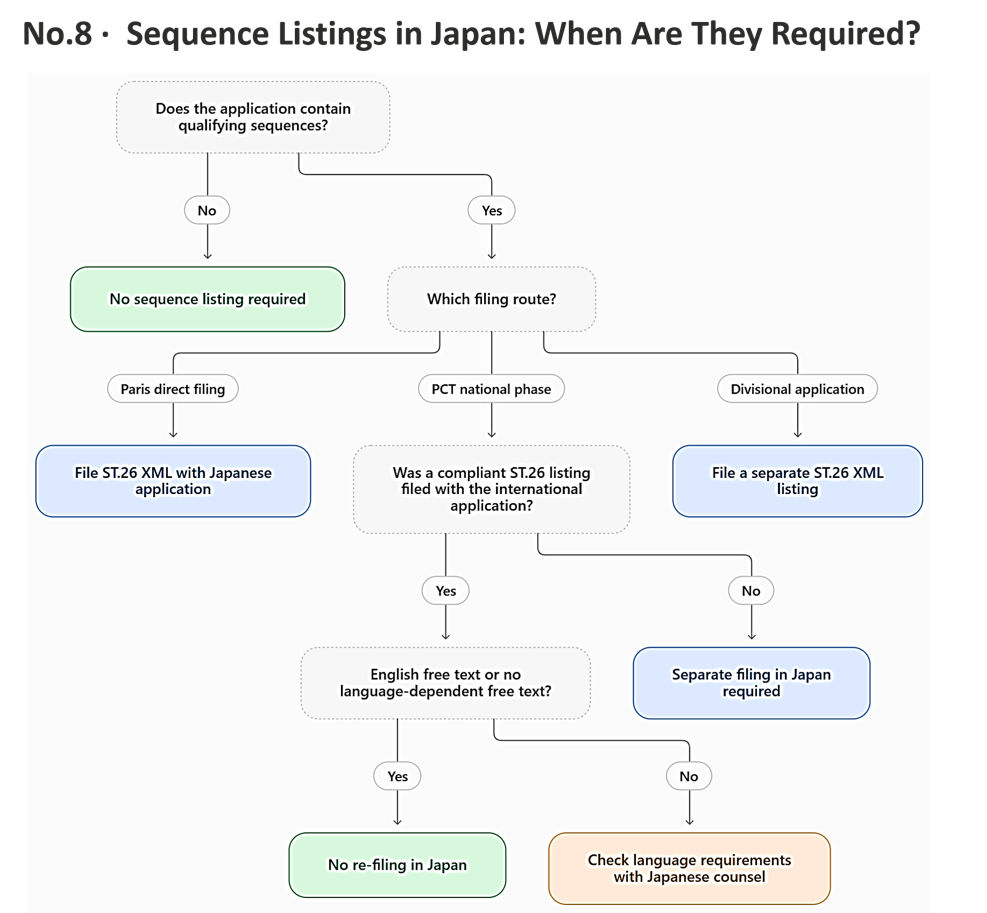
In Japan, applications filed on or after July 1, 2022 (for PCT applications, the international filing date) generally require a sequence listing in XML format that complies with WIPO Standard ST.26. However, a separate submission in Japan may not be necessary. This depends on the filing route and on whether a sequence listing was submitted during the PCT international phase.
Why this matters
A sequence listing is generally required when the specification, claims, drawings, or other application documents contain one or more qualifying sequences. A qualifying sequence has at least 10 nucleotides or at least 4 amino acids. Additional rules apply to sequences that contain unknown nucleotides or amino acids.
The requirement applies even if the sequences are already known or are not directly related to the main invention.
Practical points
What if a sequence listing is missing?
If a required sequence listing has not been submitted, the Japan Patent Office (JPO) may issue a notice requiring correction. The JPO may also issue a notice if an application includes a sequence listing in the older ST.25 format instead of the ST.26 format. In either case, the applicant must submit the appropriate sequence listing in response to the notice.
Paris direct filing vs. PCT national phase entry
For a Paris direct filing, an ST.26-compliant sequence listing must be submitted with the Japanese application. This requirement applies even if a sequence listing was filed with the earlier foreign application.
For a PCT national phase entry, re-filing is generally unnecessary if an ST.26-compliant sequence listing was submitted with the international application. Some sequence listings contain descriptive text about sequence features or functions, known as “language-dependent free text.” In that case, re-filing is unnecessary only if the free text is provided at least in English. If the listing contains no language-dependent free text, re-filing is also unnecessary.
In some cases, no sequence listing was submitted with the international application, but one was later furnished for international search under PCT Rule 13ter. That listing does not form part of the international application. A separate sequence listing must therefore be submitted in Japan. The new listing must not introduce subject matter beyond the disclosure of the international application as filed.
If a sequence listing was submitted later during the international phase, inform Japanese counsel how it was submitted. For example, it may have been furnished for international search, or submitted through a formal amendment or another procedure.
Divisional applications
The sequence-listing requirement applies separately to each application. If a divisional application contains qualifying sequences, a sequence listing must be submitted. This applies even if the same listing was already filed with the parent application.
A divisional application filed on or after July 1, 2022 generally requires an ST.26-compliant sequence listing. This applies even if the parent application was filed before that date with a listing in the older ST.25 format.
What to prepare for Japanese counsel
- An ST.26-compliant sequence listing (XML file), unless re-filing is unnecessary for a PCT national phase entry
- For a PCT application, confirmation of whether a sequence listing was submitted with the international application or later during the international phase
- For a divisional application, an ST.26-compliant sequence listing prepared for the divisional application
Takeaway
In Japan, patent applications that contain qualifying nucleotide or amino-acid sequences generally require a sequence listing. If the listing is missing or filed in the wrong format, the JPO may issue a notice requiring correction.
For Paris direct filings, a sequence listing must be submitted with the Japanese application. For PCT national phase entries, re-filing is generally unnecessary if an ST.26-compliant listing was submitted with the international application and meets Japan's requirements.
For divisional applications, a sequence listing must be submitted separately, even if the same listing was filed with the parent application.
Official basis checked: JPO Q&A and filing guidance on WIPO Standard ST.26 sequence listings; WIPO Standard ST.26 and PCT Rule 13ter (current as of November 2026).
This article is for general informational purposes only and does not constitute legal advice. Rules and practice may change, and outcomes depend on individual circumstances. For specific matters, please consult qualified patent counsel.
Member



SHARE