
ブログ
[Series] Japan IP Dispute Resolution 101 - Part 1: An Overview of IP Litigation in Japan
2026.06.29
SHARE


Welcome to our new series, "Japan IP Dispute Resolution 101," where we will introduce both the legal framework and the practical realities of handling IP disputes in Japan. Whether you are looking to protect your rights through IP enforcement or defend against infringement claims, this series will provide the essential insights you need to navigate the system.
In this first installment, I will cover the foundational concepts and procedural rules of Japanese IP litigation. Please stay tuned for Part 2, where I will dive deeper into matters specific to patent litigation in Japan.
Court Jurisdiction for IP Cases in Japan
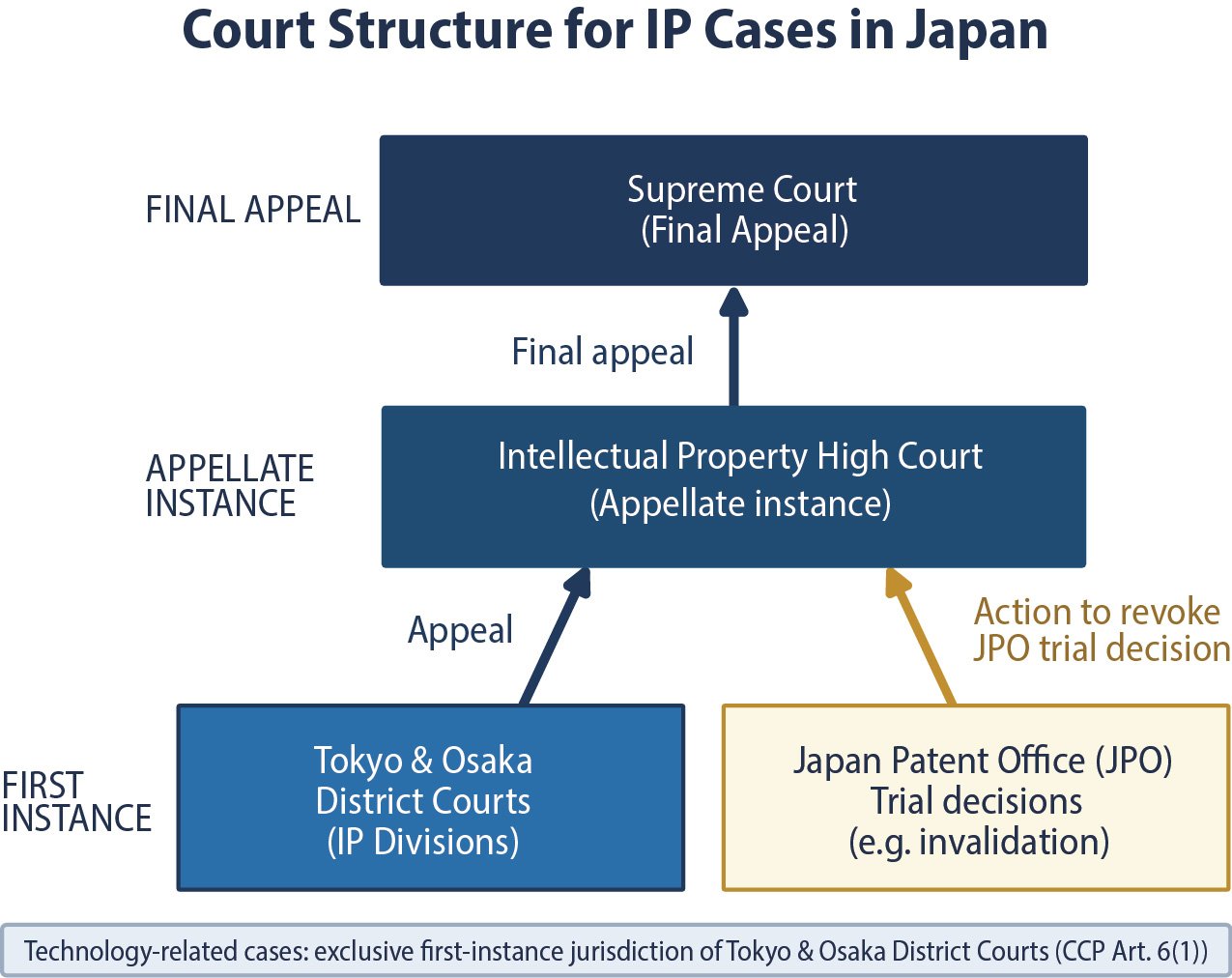
Basic court structure. The Japanese judicial system operates on a three-tier structure: typical civil proceedings begin at a District Court (first instance), proceed to a High Court (appellate instance), and conclude at the Supreme Court (final appeal).
Specialized IP divisions in Tokyo and Osaka. At the District Court level, the Tokyo District Court and the Osaka District Court each have specialized Intellectual Property Divisions. These divisions handle and concentrate on IP-related matters, including claims concerning patents, utility models, designs, trademarks, copyrights, and layout-design exploitation rights, as well as cases related to the Unfair Competition Prevention Act and publicity rights.
Technology-related cases and exclusive jurisdiction. Furthermore, within IP disputes, "technology-related cases" are subject to the exclusive jurisdiction of the Tokyo and Osaka District Courts among all district courts nationwide (Code of Civil Procedure, Article 6(1)). “Technology-related cases” are those involving patents, utility models, layout-design exploitation rights, or computer program copyrights.
The Intellectual Property High Court:
For appellate proceedings, any IP case appealed from the Tokyo District Court falls under the jurisdiction of the Intellectual Property High Court (IP High Court). Likewise, appeals for “technology-related cases” originating from the Osaka District Court are exclusively directed to the IP High Court (Code of Civil Procedure, Article 6(3); Act for Establishment of the Intellectual Property High Court, Article 2(1)).
Concentrating these cases within the highly specialized IP High Court, which comprises judges and judicial research officials with deep expertise in IP rights, ensures comprehensive, expedited proceedings and promotes the early unification of judicial precedents. Consequently, rulings by the IP High Court attract significant attention and hold substantial weight in Japanese IP litigation practice. This is especially true for rulings rendered by the Grand Panel, a special panel composed of five judges (as opposed to the standard three-judge panel) that hears cases involving significant legal issues requiring a unified interpretation of the law.
The IP High Court also holds exclusive jurisdiction over actions for the revocation of trial decisions made by the Japan Patent Office (JPO), such as those regarding the invalidation of patents, trademarks, or designs (Patent Act, Article 178(1); Act for Establishment of the Intellectual Property High Court, Article 2(2)).
Important Notes on Court Structure:
- The IP divisions of the IP High Court and other courts do not handle criminal cases (such as criminal offenses for IP infringement).
- In Japan, there is no jury system for civil matters, including IP disputes. (I will discuss the involvement of judicial research officials and technical advisors in patent litigation in a future installment).
Two-Stage Proceedings at the District Court
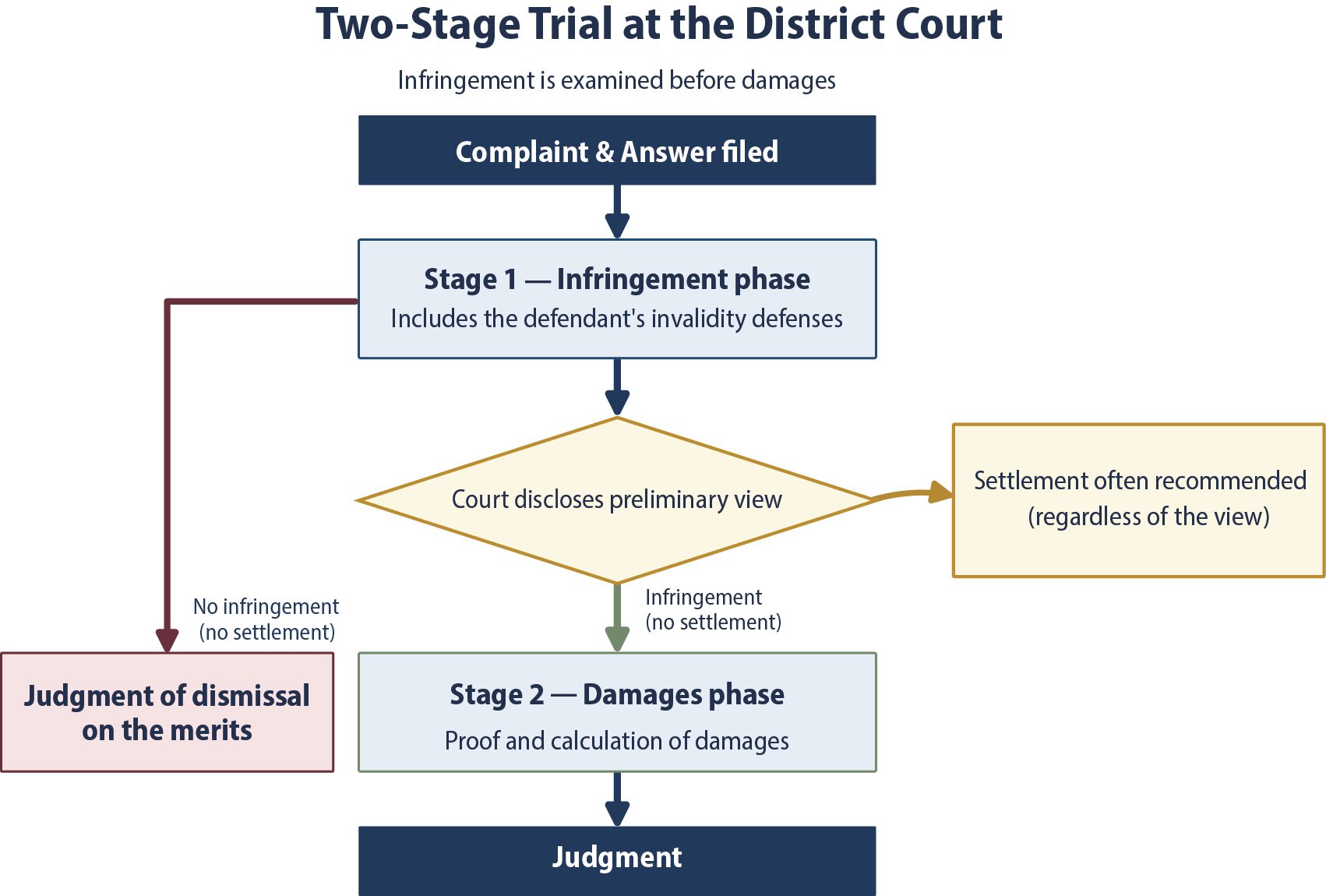
One of the most important procedural features of Japanese IP litigation is its two-stage proceeding model within the district court proceedings:
- Stage 1: Infringement Phase: The court first examines whether infringement is established (which includes arguments on invalidity defenses). Once both parties finish presenting all their arguments, the court will disclose its preliminary view regarding the presence or absence of infringement.
- Stage 2: Damages Phase: Only if the court announces its preliminary view that infringement is established, the proceedings will advance to the second stage—the calculation of damages
For rights-holders initiating a lawsuit, this means it is necessary to prioritize the assertion and proof of infringement before moving on to the detailed proof and calculation of damages. Additionally, when the court discloses its preliminary view of infringement before transitioning to the damages phase, it will often recommend a settlement and designate a date for settlement negotiations
Timeline and Average Duration of IP Litigation in Japan
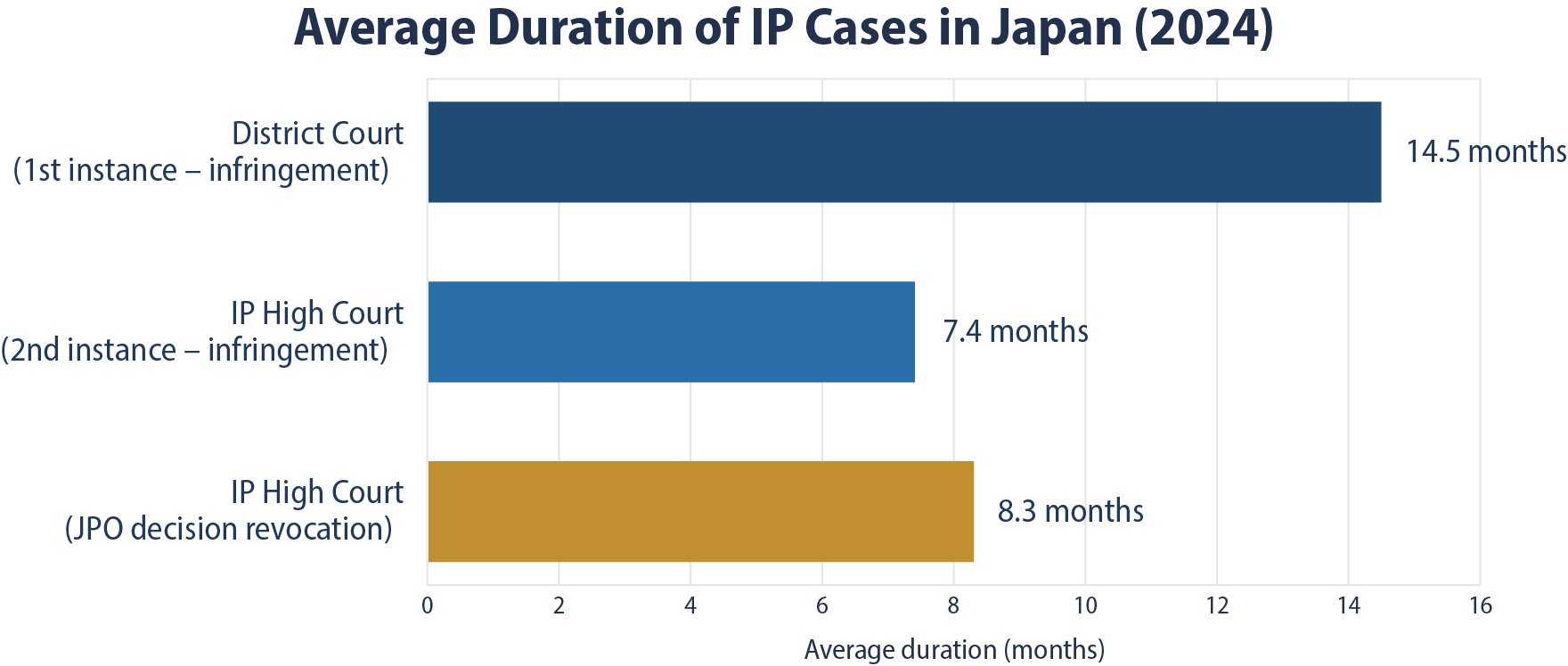
According to publicly available data from the courts, the average duration for IP-related civil cases in 2024 was:
- District Courts (First Instance): 14.5 months
- IP High Court (Appeals): 7.4 months
- Actions for Revocation of JPO Decisions: 8.3 months
E-Filing and Digitalization of Japanese Court Procedures
The Japanese judiciary has been gradually integrating IT into its civil proceedings since 2020, allowing parties to attend hearing dates via web conferencing and submit certain court documents online.
Taking this a step further, under the amended Code of Civil Procedure that recently came into effect on May 21, 2026, the entire civil litigation process—from the filing of a complaint to the issuance of a judgment—has been fully digitalized.
- E-Filing: Anyone can now file complaints, submit and receive court documents including service of process, and receive judgments online through the courts’ “mints” system. For legal counsel, such as attorneys, utilizing these online procedures is now mandatory. (Note: Currently, the court system cannot be accessed from outside Japan).
- Electronic Records: For cases filed on or after May 21, 2026, all litigation records are managed electronically within the courts’ “mints” system. Parties to a case can access and review the litigation records online at any time.
- Third-Party Access: Third parties with a legal interest to a case may view or copy the relevant records online from their own computers only with the permission of a court clerk. Third parties without a legal interest to a case must visit their nearest court in person to view the records on a court-provided terminal.
- Hearings & Testimony: While witness examinations can now be conducted remotely via web conferencing under certain strict conditions, spectator observation (which resembles public gallery seating) is not available online and remains restricted solely to the physical courtrooms.
Preliminary Injunctions (PI) vs. Main IP Litigation in Japan
When seeking to enjoin an infringement of IP rights, a party can file a motion for a Preliminary Injunction (PI) order seeking the suspension or prevention of infringement, in addition to a standard civil lawsuit.
A PI order may be issued when it is necessary to avoid substantial damage or imminent danger that would occur to the petitioner with regard to the relationship of the rights in dispute (Civil Preservation Act, Article 23(2)). The primary benefits of a PI include:
- Speed: PI proceedings are generally expected to be faster than main civil lawsuits.
- Immediate Enforcement: In a standard civil lawsuit, even if the plaintiff wins the first instance, the judgment cannot be executed if the defendant appeals. In contrast, a PI order becomes immediately enforceable upon notice (Civil Preservation Act, Article 43).
It is common practice for a plaintiff to file a main civil lawsuit and a PI petition simultaneously. In such cases, because the substantive arguments in both proceedings are nearly identical, the hearing dates often run concurrently (though this parallel processing can sometimes cause the PI to proceed slightly slower than if it were filed entirely alone).
The strategic advantage of simultaneous filing is clear: once the court confirms infringement, the petitioner can immediately obtain an enforceable PI order to halt the infringing activities. This secures immediate injunctive relief while the main lawsuit continues into the damages phase. It is important to note, however, that financial compensation cannot be claimed in PI proceedings; therefore, any claim for damages must be pursued concurrently within the main civil lawsuit.
Member
PROFILE

SHARE