
ブログ
[Series] Japan IP Dispute Resolution 101 - Part 2: The Basic Framework of Patent Litigation in Japan
2026.06.30
SHARE


This series "Japan IP Dispute Resolution 101" provides a practical guide to handling IP disputes in Japan. Building on the foundational overview of IP litigation in Part 1, this article introduces the distinctive features of Japanese patent litigation, including court composition, procedural framework, substantive legal issues, and the relationship between the judiciary and the Japan Patent Office (JPO).
Composition of the Bench in Patent Litigation
Patent litigation in Japan is typically heard by a three-judge panel. However, given the technical complexity inherent in patent disputes—including patent infringement actions and appeals from JPO trial decisions—the Japanese court system incorporates technical expertise through two categories of specialists: judicial research officials and technical advisors. This composition of a hybrid bench distinguishes patent litigation from other forms of IP litigation (such as copyright cases) and general civil litigation.
Judicial Research Officials:
Judicial research officials are internal court staff who collaborate with the judicial panel throughout the entire duration of a case. Under the direction of the presiding judges, they conduct technical investigations, prepare analyses of complex technical issues, and assist the judges in understanding the scientific or engineering principles at the heart of the dispute.
These officials typically have professional backgrounds as JPO patent examiners (including appeal examiners) or patent attorneys (benrishi). For each case, the court assigns an official whose technical expertise aligns with the relevant field.
Technical Advisors:
In contrast, technical advisors are external experts appointed by the court on a case-by-case basis. They participate in selected court sessions, typically Technical Presentations, where they provide explanations based on their specialized knowledge. While technical advisors may clarify technical concepts for the court, their explanations do not constitute formal evidence and cannot serve as the sole basis for factual findings.
Neither judicial research officials nor technical advisors possess adjudicative authority. While all legal determinations and findings of fact are made exclusively by the three-judge panel, the participation of these judicial research officials and technical advisors enables judges to make informed decisions with a thorough understanding of the technical matters at issue, thereby enhancing the quality and reliability of patent adjudication in Japan.
Substantive Legal Issues in Patent Infringement Litigation
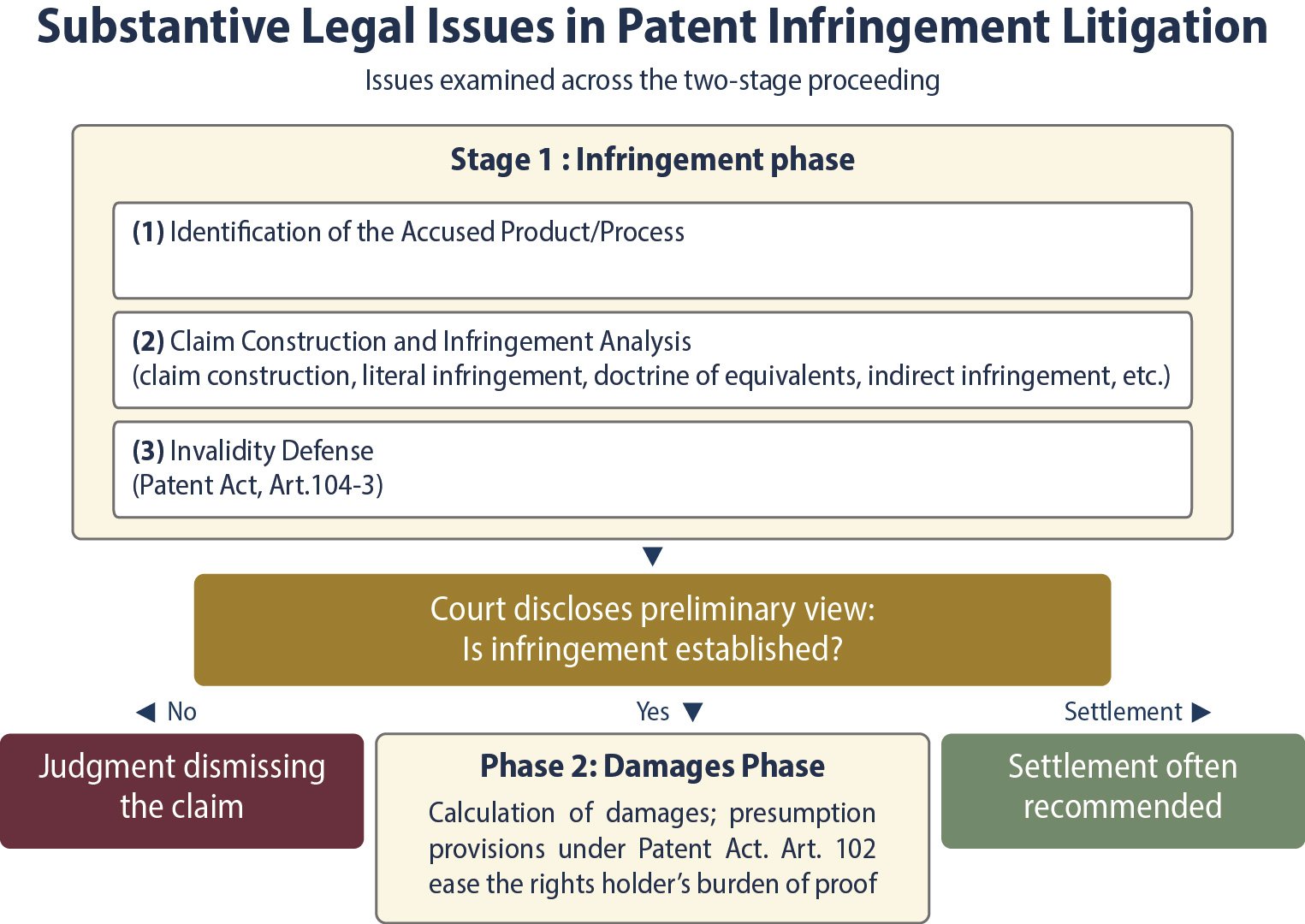
Taking patent infringement actions as an example, Japanese patent infringement actions follow a two-stage proceeding structure (introduced in Part 1). The proceedings are divided into two sequential phases: the Infringement Phase and the Damages Phase. This two-stage structure presupposes that the plaintiff seeks damages; where only injunctive relief is sought, the proceedings conclude with the Infringement Phase and no separate Damages Phase arises.
Phase 1: Infringement Phase
In the Infringement Phase, issues such as the following (1) through (3) are examined. The proceedings advance to the Damages Phase only if the court forms a preliminary view that infringement is established. It is customary for the court to disclose its preliminary view once the arguments in the Infringement Phase have been fully presented.
(1) Identification of the Accused Product/Process: At this stage, the court examines whether the defendant’s product or process is sufficiently identified.
(2) Claim Construction and Infringement Analysis: The court determines whether the defendant’s product or process falls within the technical scope of the patented invention. Issues such as claim construction, literal infringement, the doctrine of equivalents, and indirect infringement arise at this stage.
(3) Invalidity Defense: The court examines whether the patent contains grounds for invalidation. Under Article 104-3 of the Patent Act, the defendant may assert that the patentee cannot exercise its rights when the patent should be invalidated through an invalidation trial.
Phase 2: Damages Phase
Only after the court forms a preliminary view of infringement following the examination of issues (1) through (3) do the proceedings move to the assessment of damages. The claim for damages arises in tort under Article 709 of the Civil Code; the Patent Act does not create an independent cause of action but supplements this framework with special rules. Regarding the calculation of damages, presumption provisions are established under Article 102 of the Patent Act, which serve to reduce the burden of proving the amount of damages.
Technical Presentations (Gijutsu Setsumeikai)
A Technical Presentation (Gijutsu Setsumeikai) is a proceeding in which judges, judicial research officials, and technical advisors receive explanations from the parties regarding the content of the invention and the underlying technology. In patent litigation, this procedure is frequently conducted during the Infringement Phase, particularly in technically complex cases.
In most instances, both parties, the judges, judicial research officials, and technical advisors participate. Each party first delivers a presentation, after which the judges, judicial research officials, and technical advisors pose questions to the parties.
This procedure enables the judges, who are responsible for adjudication, to develop a deeper understanding of the inventions and technologies at issue in the litigation. Technical Presentations play an important role in enhancing the quality of proceedings in technically complex cases, and both parties should fully utilize them as a valuable opportunity to convey technical matters clearly to the judges.
The “Double Track” System for Patent Invalidity Determinations
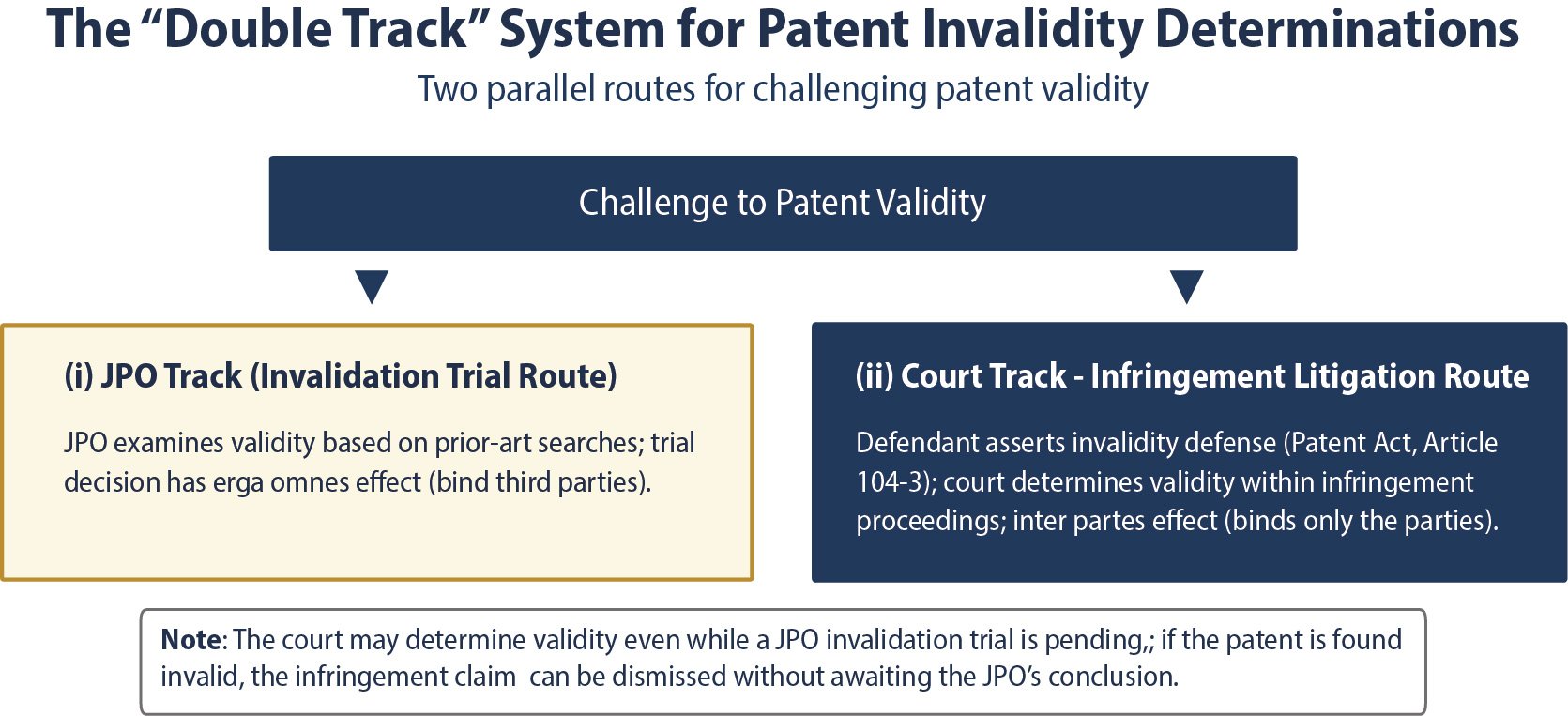
In Japan, a “Double Track” system is in place under which two parallel routes exist for challenging the validity of a patent:
(i) JPO Track (Invalidation Trial Route): A party may file a request for an invalidation trial with the JPO. The JPO examines the validity of the patent based on prior art searches and other relevant materials. The resulting trial decision has erga omnes effect (i.e., binding on third parties beyond the parties to the invalidation trial).
(ii) Court Track (Infringement Litigation Route): In infringement litigation, the defendant may directly assert an “invalidity defense” (Patent Act, Article 104-3). The court has the authority to determine the validity of a patent within infringement proceedings, and it exercises this authority in practice. Such a determination has inter partes effect only (i.e., binding solely on the parties to the litigation).
Under this system, even while an invalidation trial is pending before the JPO, the court may determine patent validity within the infringement proceedings. If the court concludes that the patent is invalid, it can dismiss the infringement claim without waiting for the JPO’s conclusion. On the other hand, a defendant may also file an invalidation trial with the JPO in parallel with the litigation.
Statistics on the Double Track:
According to JPO statistics for patent infringement actions with judgment dates in 2023, invalidation trials were pending for the corresponding patents in 60% of cases. Among those, an invalidity defense was asserted in 90% of the litigation cases.
Furthermore, according to JPO compilations for patent infringement actions with judgment dates between 2019 and 2023, the consistency rate between the conclusions reached in invalidation trials and the validity/invalidity determinations in district court judgments was 81%.
Key Statistics on Patent Infringement Litigation
When filing or defending a patent infringement action in Japan, understanding the likely outcomes and the level of damages awarded is important for formulating litigation strategy and settlement negotiations. The following presents key statistics on patent infringement litigation based on data published by the courts (FY2015–FY2024, IP Divisions of the Tokyo and Osaka District Courts).
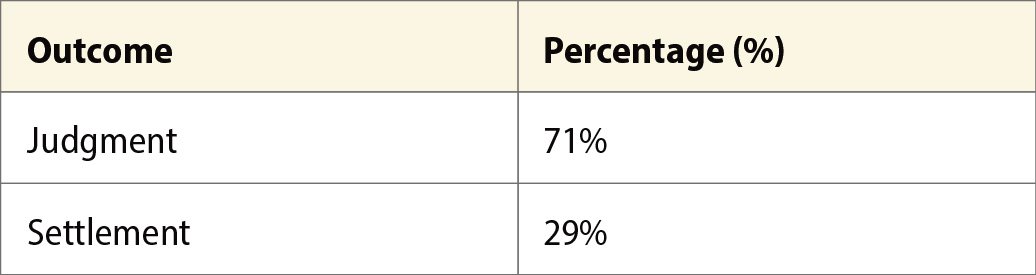
(1) Case Outcomes: Ratio of Judgments to Settlements
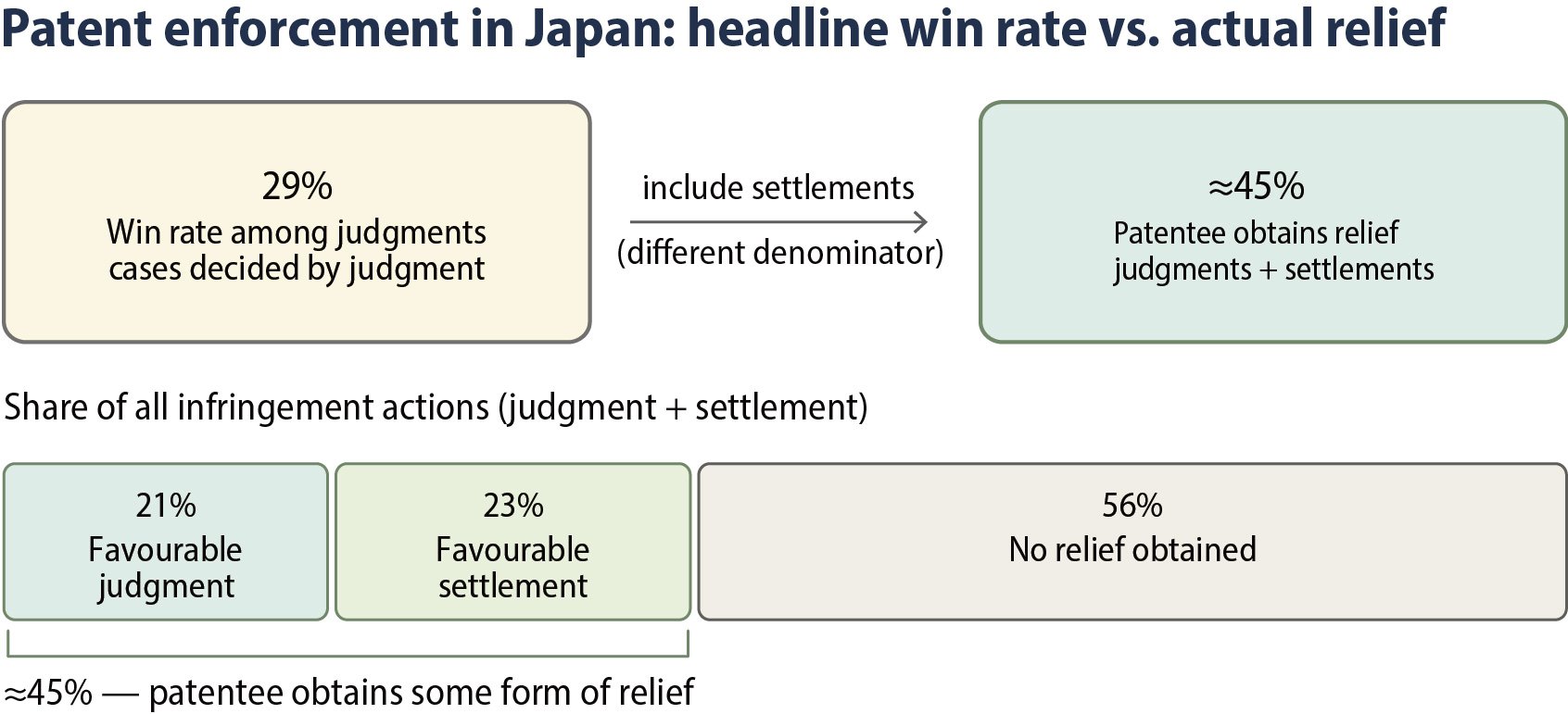
Approximately 71% of patent infringement actions conclude with a final judgment, while approximately 29% conclude through a settlement.
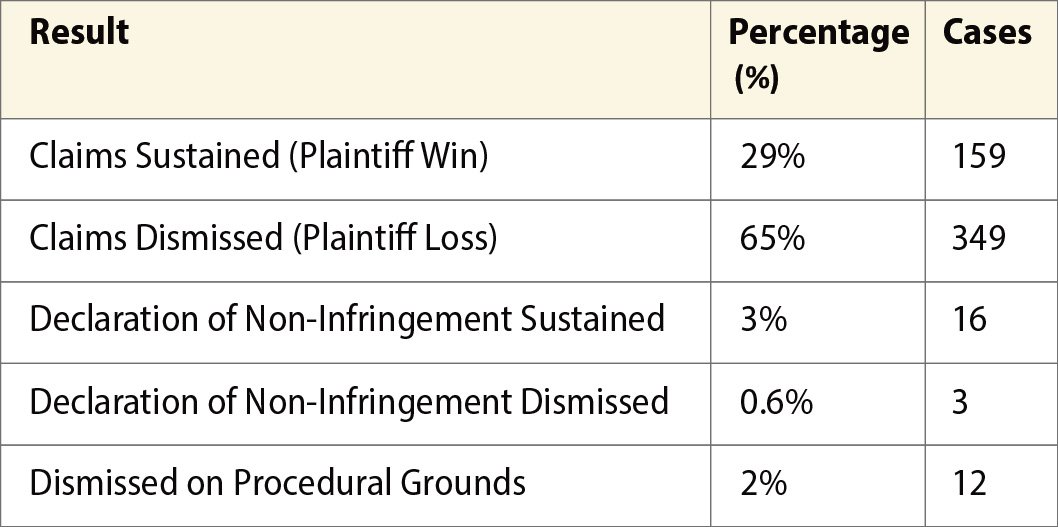
(2) Judgment Results (Plaintiff Success Rate)
Among cases that proceeded to judgment, patent plaintiffs prevail in approximately 29% of litigated cases, while defendants prevail in approximately 65%. This figure, however, reflects only cases decided by judgment and understates the practical prospects of enforcement. Settlements account for roughly 29% of all actions (see (1) above), and approximately 80% of those settlements include injunctive relief and/or a payment obligation in the patentee's favor. Taking plaintiff-favorable judgments and such settlements together, the patentee obtains some form of relief in roughly 45% of all infringement actions. For a rights holder considering enforcement in Japan, the realistic likelihood of securing relief is therefore materially higher than the headline judgment-based rate suggests.
Note: “Declaration of Non-Infringement Sustained” refers to actions initiated by the accused infringer seeking a declaratory judgment of non-infringement against the patent holder. In these cases, the “defendant” is the patent holder and the “plaintiff” is the accused infringer.
(3) Distribution of Damages Awarded
Among judgments in favor of the plaintiff, the distribution of damages awarded is as follows.
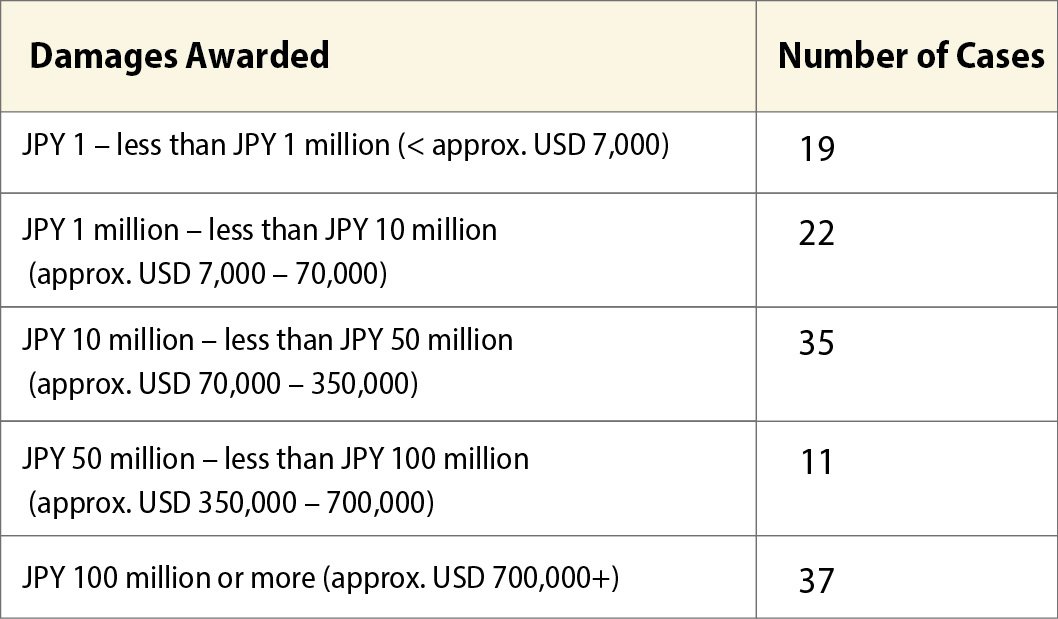
While there are 37 cases (approximately 30%) with awards of JPY 100 million (approx. USD 700,000) or more, a substantial number of cases involve awards of less than JPY 10 million (approx. USD 70,000), indicating a wide range in damage amounts.
Member
PROFILE

SHARE