
ブログ
[Amendments to the Medical Care Act] Series: The 2025 Medical Care Act Amendments and the Regulation of Telemedicine – Part 2: From Guidelines to Ministerial Ordinances
2026.08.18
SHARE


Introduction
Part 1 of this series outlined the legislative developments leading to the 2025 amendments to the Medical Care Act and the background to those amendments.
In Part 2, we examine the substantive changes introduced by the amended Medical Care Act.
This article explains the overall regulatory framework governing telemedicine under the amended Medical Care Act. Part 3 will then examine in detail the Telemedicine Guidelines discussed below.
Regulatory Framework Prior to the Amendments and Its Limitations
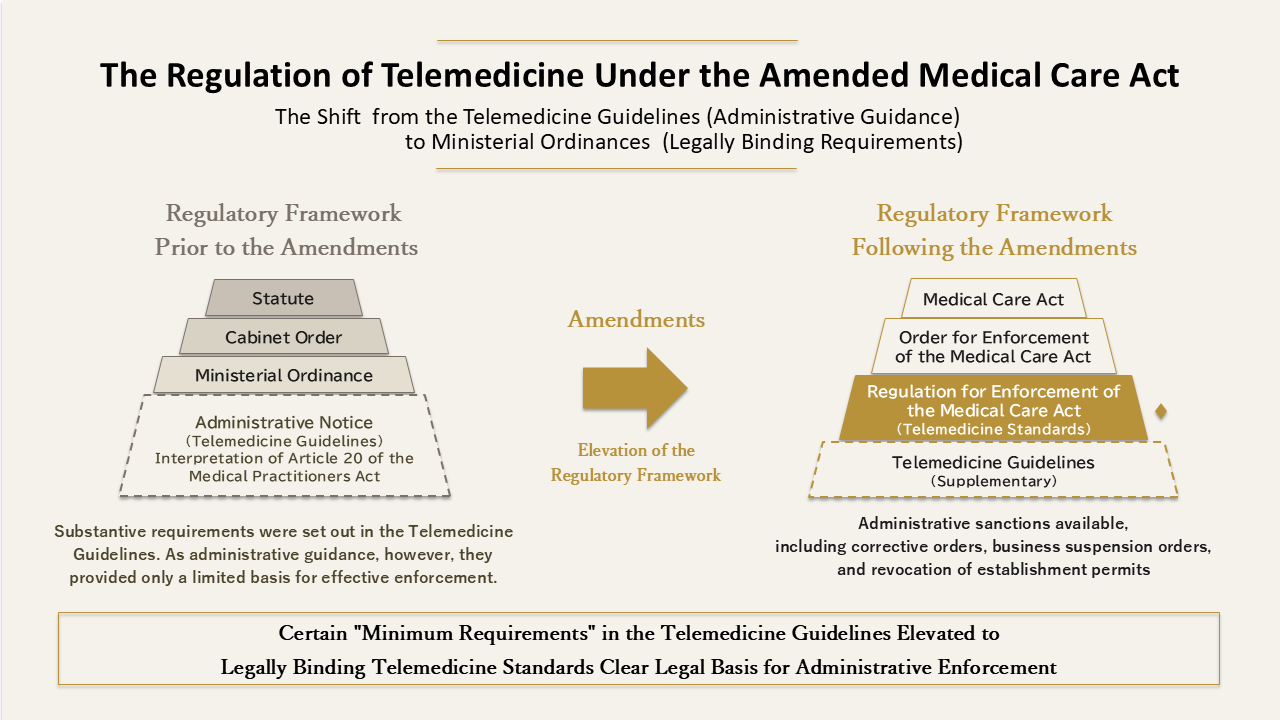
Before the amended Medical Care Act came into force, the primary regulatory framework governing telemedicine was set out in the Telemedicine Guidelines, an administrative notice reflecting the Ministry of Health, Labour and Welfare's interpretation of the relevant legislation. More specifically, although the Japanese legal hierarchy comprises statutes (such as the Medical Care Act and the Medical Practitioners Act), cabinet orders (such as the Order for Enforcement of the Medical Care Act), and ministerial ordinances (such as the Regulation for Enforcement of the Medical Care Act), the substantive rules governing telemedicine were largely set out in administrative guidance. While this framework allowed for flexible regulatory administration, it also exposed the limitations of relying on administrative guidance as the principal regulatory basis, particularly from an enforcement perspective.
For a more detailed discussion, see Part 1: The Evolution of the Regulatory Framework Governing Telemedicine and the Background to the Amendments
Regulatory Framework Following the Amendments
One of the most significant changes introduced by the amendments is that certain requirements previously governed solely by the Telemedicine Guidelines have been elevated to ministerial ordinance level, making them legally binding. Specifically, Article 14-3 of the Medical Care Act requires the Minister of Health, Labour and Welfare to establish, by ministerial ordinance, standards for the appropriate provision of telemedicine (the "Telemedicine Standards"). The Medical Care Act further provides that telemedicine must be conducted in accordance with those Telemedicine Standards.
|
Article 14-3 of the Medical Care Act |
The Telemedicine Standards are set out in Articles 9-6-3 through 9-6-19 of the Regulation for Enforcement of the Medical Care Act. These provisions incorporate into a ministerial ordinance certain requirements that had previously been identified in the Telemedicine Guidelines as the "minimum requirements" for compliance.
Failure to comply with the Telemedicine Standards may result in administrative sanctions, including a corrective order issued by the relevant prefectural governor or other competent authority (Article 24-2(1) of the Medical Care Act), a business suspension order (Article 24-2(2)), and, where a business suspension order is violated, revocation of the establishment permit or an order to close the medical institution (Article 29(1)).
At the same time, the Telemedicine Guidelines have not been repealed following the entry into force of the amended Medical Care Act. They remain in effect and continue to serve a complementary role by providing guidance that supplements the Telemedicine Standards prescribed by ministerial ordinance.
Fundamental Principles Under the Amended Medical Care Act
The amended Regulation also sets out the fundamental principles governing telemedicine. Article 9-6-3 of the Regulation for Enforcement of the Medical Care Act provides that telemedicine is intended to achieve the following three objectives:
(1) improving the quality of medical care;
(2) ensuring patients' access to medical care; and
(3) maximizing treatment outcomes through patients' active participation in their own treatment.
At the same time, the Regulation identifies the following key characteristics of telemedicine that should be taken into account:
(i) because telemedicine relies on information and communications technology and enables physicians and patients to assess each other's condition through the transmission and reception of audio and visual information, the information that can generally be obtained regarding a patient's physical and mental condition is more limited than in an in-person consultation;
(ii) telemedicine is, in principle, expected to be provided in appropriate combination with in-person consultations; and
(iii) telemedicine should be provided at the request of the patient and must not be conducted primarily for research purposes or solely for the convenience of healthcare providers.
Of these, the first two are particularly important. The Regulation recognizes that information obtained through video consultations is generally more limited than that available during in-person consultations. Accordingly, telemedicine is expected to be used in appropriate combination with in-person consultations. The Regulation proceeds on the basis that information obtained through video consultations is generally more limited than that available during in-person consultations.
In Part 2 of this series, we have outlined the regulatory framework governing telemedicine under the amended Medical Care Act. Part 3 will examine the substantive requirements of the Telemedicine Standards in greater detail.
[Related Links]
■ Amendments to the Medical Care Act
• Act Partially Amending the Medical Care Act and Other Acts
https://www.mhlw.go.jp/content/001681278.pdf
• Cabinet Order Partially Amending the Order for Enforcement of the Medical Care Act and Related Orders
https://www.mhlw.go.jp/content/001681281.pdf
• Ministerial Ordinance Partially Amending the Regulation for Enforcement of the Medical Care Act and Related Regulations
https://www.mhlw.go.jp/content/001681282.pdf
• "Q&A on Telemedicine" (Issued in March 2026)
https://www.mhlw.go.jp/content/001681026.pdf
■ Implementation Notice
• "Partial Enforcement of the Act Partially Amending the Medical Care Act and Other Acts (Telemedicine)" (Medical Affairs Bureau Director's Notice No. Isei-Hatsu 0327-5, dated March 27, 2026)
https://www.mhlw.go.jp/content/001681277.pdf
■ Telemedicine Guidelines and Q&A (April 2026 Revision)
• Guidelines for the Appropriate Practice of Telemedicine (Revised in April 2026)
https://www.mhlw.go.jp/content/001685701.pdf
• Q&A on the Guidelines for the Appropriate Practice of Telemedicine
https://www.mhlw.go.jp/content/001686805.pdf
■ Reference: MHLW "Telemedicine"
https://www.mhlw.go.jp/stf/index_0024_00004.html
Member
PROFILE

SHARE