
ブログ
[Act on Prevention of Transfer of Criminal Proceeds] AML/CFT Measures for Businesses (DNFBPs)
2026.10.13
SHARE


Introduction
The latest edition (2025) of the Annual Report on the Prevention of the Transfer of Criminal Proceeds, published by the Japan Financial Intelligence Center (JAFIC), features, as a special topic, efforts by Designated Non-Financial Businesses and Professions (DNFBPs) to combat money laundering and related matters. Japan's efforts to combat money laundering have traditionally been led by financial institutions and other entities under the supervision of the Financial Services Agency. The fact that DNFBPs were featured as a special topic in this year's annual report symbolizes the expansion of policy focus to businesses other than financial institutions.
Businesses that fall within the scope of DNFBPs are expected to take the recent amendments to the relevant laws as an opportunity to review their own AML/CFT measures.
What are DNFBPs?
DNFBP is an abbreviation for Designated Non-Financial Businesses and Professions, referring to designated non-financial businesses and professions. DNFBPs are included among the so-called “gatekeepers” subject to the recommendations of the Financial Action Task Force (FATF). Compared with financial institutions and other entities, however, there are greater variations in the level of measures taken by DNFBPs, making it an ongoing challenge to strengthen their efforts.
Specifically, the following types of businesses fall within the scope of DNFBPs in Japan (listed together with the relevant government agency):
|
Real estate transaction businesses |
Ministry of Land, Infrastructure, Transport and Tourism |
|
Businesses handling jewelry, precious metals, etc. |
Ministry of Economy, Trade and Industry National Police Agency |
|
Mail receiving service providers |
Ministry of Economy, Trade and Industry |
|
Telephone answering service providers |
Ministry of Internal Affairs and Communications |
|
Call forwarding service providers |
Ministry of Internal Affairs and Communications |
Certain regulated professional services (attorneys, judicial scriveners, administrative scriveners, certified public accountants, and tax accountants) are also conceptually included within the scope of DNFBPs. However, as the issues relating to these professions differ from those arising in ordinary corporate legal practice, they are not covered in this article. In addition, NPOs are not included within the scope of DNFBPs. FATF Recommendation 8, however, calls for measures to address the risk of terrorist financing involving non-profit organizations, and the Cabinet Office has published relevant guidelines. As these types of NPO-related issues also differ from legal matters concerning for-profit businesses, such matters are not covered in this article.
What Is AML/CFT?
AML stands for Anti-Money Laundering, referring to measures to combat money laundering.
CFT stands for Countering the Financing of Terrorism, referring to measures to counter the financing of terrorism. AML and CFT are sometimes collectively referred to as AML/CFT. In the context of international financial policy, AML/CFT/CPF is also used as a collective term to refer to measures addressing money laundering, terrorist financing, and CPF (Counter Proliferation Financing), which concerns the provision of funds or financial services to persons who are subject to measures such as asset freezes because they are considered to be involved in the development, possession, export, or other activities relating to weapons of mass destruction, etc.
The Foreign Exchange and Foreign Trade Act and the Act on Special Measures Concerning Freezing of Assets, etc. of International Terrorists do not fall within the scope of this article, which focuses on the Act on Prevention of Transfer of Criminal Proceeds, but they are important for businesses engaged in foreign transactions.
Necessity of AML/CFT Measures for Businesses
DNFBPs are required to take the following measures:
- Comply with the obligations of Specified Business Operators under the Act on Prevention of Transfer of Criminal Proceeds (Section 4);
- Comply with guidelines published by the relevant supervisory authorities (Section 5);
- As a prerequisite, understand the risk-based approach and effectiveness verification (Section 6); and
- Comply with other laws and regulations relating to AML/CFT measures.
In addition, Japan's Action Plan for Countering Money Laundering, Terrorist Financing and Proliferation Financing (FY2024–FY2026), formulated in anticipation of the FATF Fifth Round of Mutual Evaluations of Japan, which is scheduled to commence in 2027, sets out the following three items concerning DNFBPs:
- Enhancing DNFBPs' understanding of risks and promoting measures based on a risk-based approach, etc.;
- Strengthening inspections and supervision of DNFBPs by supervisory authorities based on a risk-based approach; and
- Further promoting and improving the reporting of suspicious transactions.
Obligations under the Act on Prevention of Transfer of Criminal Proceeds
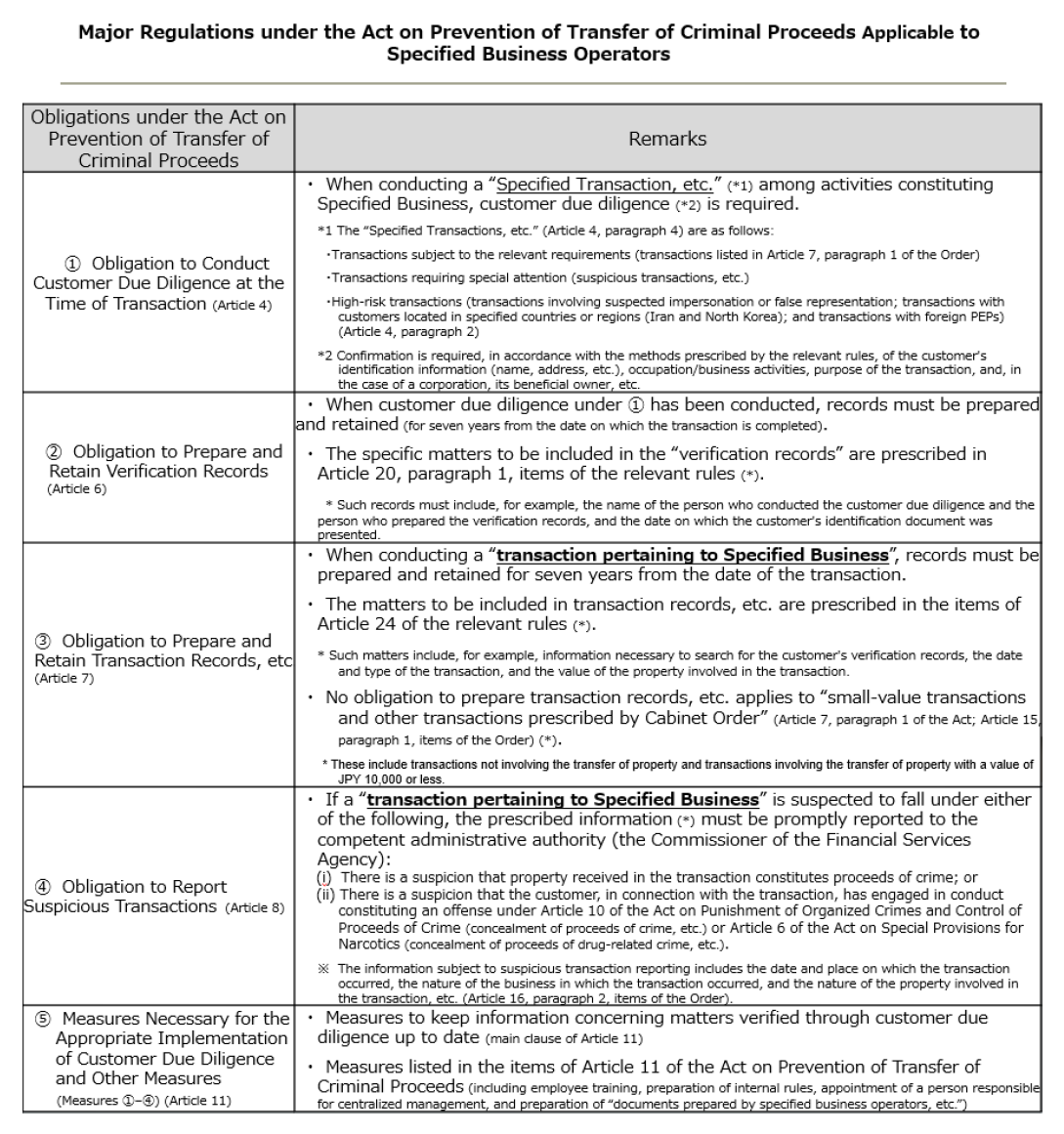
The following measures are prescribed as the “measures” referred to in Table ⑤:
- Implementation of employee training
- Preparation of internal rules
- Appointment of a person responsible for centralized management
- Preparation of risk assessment documents (Article 32, paragraph 1 of the relevant rules)
- Organization, collection, and analysis of information (Article 32, paragraph 2 of the relevant rules)
- Ongoing review of records (Article 32, paragraph 3 of the relevant rules)
- Approval procedures for certain transactions (Article 32, paragraph 4 of the relevant rules)
- Collection of information, preparation of records, etc. concerning the above transactions (Article 32, paragraph 5 of the relevant rules)
- Recruitment of employees (Article 32, paragraph 6 of the relevant rules)
- Conduct of audits (Article 32, paragraph 7 of the relevant rules)
Guidelines Issued by Relevant Ministries and Agencies
The guidelines issued by relevant ministries and agencies provide guidance for monitoring the status of compliance, etc. of companies under their respective jurisdictions. Although these guidelines do not constitute laws or regulations, non-compliance may result in administrative guidance or administrative sanctions under the laws and regulations governing the relevant business. DNFBPs therefore need to understand the contents of the guidelines applicable to them.
Guidelines Published by Relevant Ministries and Agencies
Ministry of Land, Infrastructure, Transport and Tourism: “Guidelines on Anti-Money Laundering, Countering the Financing of Terrorism, and Countering Proliferation Financing in the Real Estate Transaction Business”
https://www.mlit.go.jp/tochi_fudousan_kensetsugyo/const/tochi_fudousan_kensetsugyo_const_tk3_000001_00040.html
Ministry of Economy, Trade and Industry: “Guidelines for Businesses Handling Precious Stones and Precious Metals, etc.”
https://www.meti.go.jp/policy/mono_info_service/hoseki_kikinzoku/jigyosha.html
National Police Agency: “Antique and Secondhand Goods Dealers and Pawnbrokers”
https://www.npa.go.jp/bureau/safetylife/kobutsu/index.html
Ministry of Economy, Trade and Industry: “Guidelines for Mail Receipt Service Businesses / Private Mailbox Businesses”
https://www.meti.go.jp/policy/commercial_mail_receiving/
Ministry of Internal Affairs and Communications: “Act on Prevention of Transfer of Criminal Proceeds (For Call Reception Agency Businesses and Call Forwarding Service Providers)”
https://www.soumu.go.jp/main_sosiki/joho_tsusin/d_syohi/money/top.html
Risk-Based Approach
A risk-based approach is an approach under which, based on the premise that the resources that each specified business operator can devote to countermeasures are limited, the operator identifies and assesses its own risks and reduces overall risks to within an acceptable level by implementing stringent measures for high-risk transactions and simplified measures for low-risk transactions. As this is a concept adopted by the FATF, the measures taken by governments in various countries also adopt a risk-based approach, and this approach is reflected in the guidelines referred to above and elsewhere. In short, rather than applying one-size-fits-all measures, businesses are required to analyze and assess the circumstances surrounding their own business and implement specific measures accordingly.
However, there are also some misunderstandings regarding the risk-based approach (as opposed to a rule-based approach). For example, some specified business operators appear to mistakenly believe that, because the approach is risk-based, the requirements for customer due diligence at the time of transaction under the Act on Prevention of Transfer of Criminal Proceeds may be relaxed for persons subject to, for example, SDD (Simplified Due Diligence based on risk). However, even under a risk-based approach, the regulations are based on rules, and there is an obligation to comply with the customer due diligence requirements at the time of transaction prescribed by the Act.
Perspective of Effectiveness
In AML/CFT measures, businesses are required not only to establish formal systems, but also to demonstrate results.
One of the indicators of effectiveness is the reporting of suspicious transactions (Article 8 of the Act). According to the most recent annual report, of the 1,019,405 suspicious transaction reports filed during 2025, the number filed by DNFBPs was 439, accounting for only approximately 0.04% of the total. Looking at the contents of the reports, although financial institutions have reported transactions involving DNFBPs, there have been no reports from the businesses on the other side of those transactions. The annual report therefore states that “it may be inferred that a large number of suspicious transactions are potentially present in transactions involving DNFBPs.”
In addition, in April 2026 for real estate transactions and in June of the same year for precious stones and precious metals, the relevant ministries and agencies issued requests to the relevant industry associations concerning the promotion of suspicious transaction reporting, etc. These requests also appear to indicate the authorities’ concerns regarding the effectiveness of AML/CFT measures.
Measures to Address the 2026 Amendments and Other Developments
(1) Strengthening of Customer Identification Methods
The Enforcement Regulations of the Act on Prevention of Transfer of Criminal Proceeds were amended between 2025 and 2026, resulting in stricter requirements for methods of customer identification. The amendments will come into force in April 2027, but preparations such as system development and informing employees of the changes are necessary. Businesses that are behind in their preparations need to accelerate their efforts to address these changes. Please refer to the second article in this series.
(2) Prevention of Misuse of Corporate Bank Accounts
The 2026 amendments to the Act on Prevention of Transfer of Criminal Proceeds strengthened regulations on the misuse of bank accounts as part of measures against financial crime. Businesses need to pay attention to the company-wide management of corporate bank accounts. If a business knowingly becomes involved in money laundering or other offenses conducted through its own accounts, this constitutes a remittance-related crime. Even without active involvement, if there is a suspicion that the company's accounts have been misused, the accounts may be subject to review of transaction details by financial institutions, freezing of the accounts, and other measures. Please refer to the third article in this series.
Business Categories Not Classified as DNFBPs
Business categories that are not classified as DNFBPs are not subject to the obligations applicable to specified business operators under the Act on Prevention of Transfer of Criminal Proceeds. However, as a matter of compliance, it goes without saying that they must not become involved in money laundering or terrorist financing.
For example, when conducting transactions with financial institutions or DNFBPs, businesses are expected to cooperate in good faith with customer due diligence and other measures conducted by those institutions and entities. In addition, if money laundering or other acts are carried out through the misuse of a company's services, the company may become subject to penalties under the Act on Punishment of Organized Crimes and Control of Proceeds of Crime, the Foreign Exchange and Foreign Trade Act, or other laws, or may be asked to cooperate with investigations. Such matters are also subject to risk management, including reputational risk. Similarly, measures to prevent the misuse of corporate bank accounts may also be necessary.
Self-Check
We have prepared a simple checklist. We hope that each company will make use of it as a reference when considering measures going forward.
TMI also provides advice tailored to the risk environment of each company. Please contact us if you require support from professionals.
AML/CFT Checklist for Operating Companies (Simplified Version)
〇 Response to the 2026 Amendments to the Act and Other Developments
☑ Do you understand the amendments to the Act and the relevant rules?
☑ Do your customer identification methods comply with the new rules? (Effective April 2027)
☑ Do you have a system in place to monitor unauthorized transfers of funds through all accounts?
◯ General
☑ Have you appointed a person responsible for centralized management? Is the designated level appropriate?
☑ Have you prepared internal rules? Are they updated as necessary?
☑ Have you prepared risk assessment documents? Are they updated as necessary?
☑ Do you provide training to employees, including those at all sales offices and overseas offices, etc.?
☑ Is an internal audit conducted? Are the results recorded?
☑ Is substantive discussion conducted at meetings of the board of directors, etc.?
☑ Where necessary, do you have reviews conducted by external professionals?
◯ Customer Due Diligence at the Time of Transaction (Article 4) and Preparation and Retention of Records (Articles 6 and 7)
☑ Are the scope of your company's Specified Business and Specified Transactions known to relevant personnel?
☑ Do your customer identification methods comply with the new rules? (Repeated above)
☑ In the case of ongoing transactions, do you appropriately conduct customer authentication (identity verification)?
☑ For corporate customers, do you appropriately verify the beneficial owner?
☑ Are verification records and transaction records, etc. appropriately prepared and retained (for seven years)?
◯ Customer Due Diligence (CDD) and Transaction Monitoring
☑ Are all customers appropriately risk-assessed?
☑ Are existing customers reassessed in a timely manner?
☑ Have you established and communicated criteria for determining high-risk transactions?
☑ Do high-risk transactions require approval from the person responsible for centralized management?
◯ Suspicious Transaction Reporting (Article 8)
☑ Are reference examples of suspicious transactions understood and shared?
☑ Do you conduct detection, monitoring, and analysis using IT systems, etc.?
☑ Do you understand the status of your company's suspicious transaction reporting and use it for risk assessment?
☑ Have you established criteria for determining whether to refuse a transaction where there is suspicion (Article 5)?
Member







SHARE